
All you need to know about alcohol consumption in Bhutan
Discover alcohol in Bhutan, from ara and local beer to whisky and wine, plus current Tuesday sales rules, drinking laws and tourist allowances.
Alcohol has a long history in Bhutanese culture. In many communities, a drink may be offered to welcome guests, celebrate an occasion or express hospitality and good wishes. Traditional alcohol also appears at festivals, social gatherings and archery tournaments.
That does not mean every Bhutanese person drinks. Alcohol is also a significant public-health concern, and Bhutan continues to balance its cultural traditions with efforts to reduce harmful consumption.
For travellers, the country offers everything from farmhouse-brewed ara to local wheat beer, Bhutanese whisky and, more recently, fine wine made from grapes grown in Bhutan.
Alcoholic drinks to try in Bhutan
1. Ara
Ara is Bhutan’s best-known traditional alcoholic drink. It is distilled from fermented grains such as rice, wheat, barley, millet, maize or buckwheat.
Homemade ara varies considerably between households. It may be served clear or cloudy, warm or at room temperature. Some preparations include butter or scrambled egg, so travellers with allergies or dietary restrictions should ask how it was made.
Ara is commonly offered at farmhouses, celebrations and archery gatherings. Because home-brewed versions are not standardised, their alcohol content can be difficult to judge.
2. Chang
Chang—or bangchang in some parts of Bhutan—is a fermented grain drink rather than a distilled spirit. It is sometimes described as a traditional beer.
Families may brew it from rice, millet, barley or other locally available grains. It is particularly associated with rural hospitality and is often served warm during colder weather.
3. Bhutanese beer
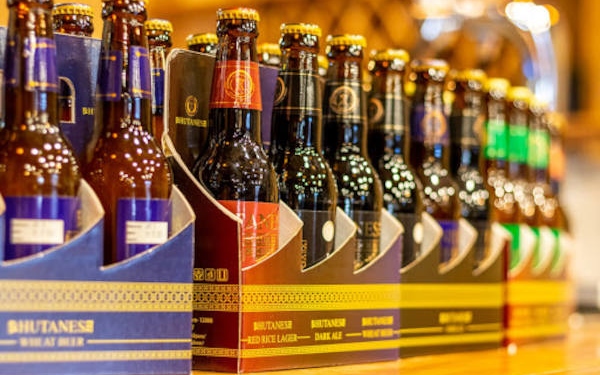
Bhutan has a surprisingly varied local beer scene, ranging from widely distributed lagers to small-batch craft brews.
Popular Bhutanese beers include:
-
Druk 11000
-
Druk Lager
-
Druk Premium
-
Red Panda Weiss Beer
-
Bhutanese Red Rice Lager
-
Bhutanese Wheat Beer
Red Panda is an unfiltered wheat beer made by Bumthang Brewery in central Bhutan. In Paro, travellers can visit Namgay Artisanal Brewery, known for beers made with Bhutanese ingredients, including its Red Rice Lager.
Brewery access and opening hours can change, so arrange visits through your guide or call ahead.
4. Bhutanese whisky and spirits
Bhutan also produces several local whiskies and spirits. Well-known names include:
-
Bhutan Grain Whisky
-
Special Courier
-
Silver Jubilee
-
Tér
K5 is named in honour of Bhutan’s fifth king. It combines Scottish malt whisky with Bhutanese grain spirit and is one of the country’s best-known premium bottles.
Travellers looking for souvenirs may find K5 Whisky through Bhutan Natural, although availability and shipping restrictions vary.
5. Bhutanese wine
Bhutan’s wine story has changed considerably in recent years.
Older local choices include Takin Red Wine, Vintria Shiraz and Zumzin Peach Wine. Zumzin is a sweet fruit wine rather than a grape wine and remains one of Bhutan’s most recognisable alcoholic souvenirs. It may be available from retailers such as the Bhutan Natural online store.
In 2019, the US-based Bhutan Wine Company and its Bhutanese partners planted the country’s first modern fine-wine vineyard at Yusipang.
That project has since moved beyond experimentation. Grapes harvested in 2024 were used for the first commercial release of Ser Kem, described by the Bhutan Wine Company as the first wine produced entirely from grapes grown in Bhutan. Its range now includes Bhutanese-grown white, rosé and red wines, although production is limited and prices are considerably higher than those of everyday local drinks.
Is Tuesday still a dry day in Bhutan?
No. Tuesday is no longer a nationwide dry day in Bhutan.
Bhutan introduced its Tuesday alcohol-sales restriction in 1999. Under the former policy, licensed bars, restaurants, hotels and alcohol retailers were not permitted to sell alcohol on Tuesdays.
The government lifted the Tuesday dry-day restriction on 4 July 2023. Licensed businesses have since been permitted to sell and serve alcohol on Tuesdays, subject to their licences, opening hours and other applicable rules.
The change followed requests from businesses and enforcement officials. Government representatives said the old restriction was difficult to monitor and did not necessarily prevent people from obtaining alcohol.
A frequently repeated story about the old policy comes from British author James Montague. He said he once asked a Bhutanese barman why Tuesday had been selected. According to the barman, there was no religious reason: authorities simply “had to pick a day.” The anecdote can still be found in Montague’s original post.
In late 2025, government officials said that discussions were underway about possibly restoring the Tuesday dry day. However, the latest published position does not show that the nationwide ban has been reinstated. Travellers should still check locally, as individual businesses may close on Tuesdays and temporary restrictions can apply during elections, religious occasions or local events.
Alcohol remains a serious health concern
The removal of Dry Tuesday does not mean Bhutan has abandoned alcohol regulation.
Alcohol is widely available. A 2019 report on alcohol outlets estimated that Bhutan had one outlet for every 177 people. More recent figures presented to Parliament indicated that the country had more than 9,500 licensed alcohol outlets—approximately one for every 75 residents.
Bhutan’s 2023 National Health Survey found that among people aged 15 to 69:
-
40.2% had consumed alcohol during the previous 12 months.
-
34.5% had consumed alcohol during the previous 30 days.
-
39.8% of recent drinkers had engaged in heavy episodic drinking.
-
30.7% reported that their household brewed alcohol at home.
Beer was the most commonly consumed alcoholic drink, followed by home-brewed ara and shingchang.
Previous reporting has also highlighted the relationship between widespread availability and alcohol-related harm in Bhutan. In 2025, Parliament cited thousands of alcohol-related liver-disease cases, nearly 3,000 drink-driving cases recorded in 2024 and substantial annual social and economic costs.
How Bhutan is responding
Bhutan adopted its National Policy and Strategic Framework to Reduce Harmful Use of Alcohol as an early coordinated response to the problem. The framework outlined strategies for reducing alcohol-related harm across ten areas:
-
Leadership, awareness and commitment
-
Health-service responses
-
Community action
-
Drink-driving policies
-
Regulation of alcohol availability and quality
-
Regulation of advertising and promotion
-
Taxation and pricing
-
Reduction of harm caused by intoxication
-
Control of illicit and informally produced alcohol
-
Monitoring and surveillance
Current measures include restrictions on sales to people under 18, licensing requirements, controls around schools and monastic institutions, drink-driving enforcement and expanded treatment services for alcohol-use disorders.
Earlier coverage of Bhutan’s proposed GST reforms referred to a planned 100% tax on alcohol. That proposal is no longer an accurate description of the current system.
Bhutan introduced a 5% Goods and Services Tax on 1 January 2026, alongside a separate excise regime. Under the Excise Tax Act of Bhutan 2025, most alcoholic beverages are taxed at Nu 1,200 per litre of pure alcohol content, in addition to applicable GST.
Can travellers bring alcohol into Bhutan?
Yes. Under Bhutan’s current duty-free baggage rules, a foreign tourist may bring in up to two bottles of liquor, with each bottle holding no more than one litre. In other words, the duty-free allowance is a maximum of two litres.
Alcohol exceeding the allowance should be declared to Customs and may be subject to tax or other requirements. Bhutan’s 2025 Indirect Tax Manual contains the current passenger allowance.
Travellers should also remember that:
-
Alcohol cannot be sold or served to anyone under 18.
-
Drinking and driving is illegal.
-
Monasteries, temples and other sacred places may prohibit alcohol.
-
Hotels, restaurants and local authorities may impose their own service hours or temporary restrictions.
-
Homemade ara can be considerably stronger than it tastes.
There is little practical need to bring much alcohol into Bhutan. Local beer, whisky, fruit wine and traditional drinks are widely available, and trying them responsibly can offer an interesting glimpse into Bhutanese hospitality and food culture.