

From Bhutan To College Campuses, Calculating Forests Into The Many Meanings Of Happiness
Forests are part of literal equations for personal and societal happiness.
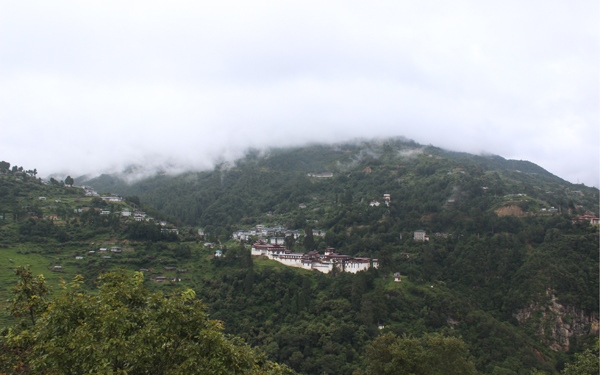 (Source: Daily Bhutan)
By Dr. Robin R. Sears | Landscape News
As a white, upper middle-class, highly educated woman from the US, I should know happiness. I have benefitted from the privileges available to me from my position on the globe and in society. I eat well, use disposable income to satisfy my whims, enjoy a comfortable and warm home, and have a gratifying career.
Yet, my happiness is highly dependent on my engagement with natural forest landscapes. The air, the humidity, the visual diversity of life, and the quiet – but not silence, as in a healthy forest one should hear the call of the chickadee, the rustle of the peccary and the hum of insects – all give me great contentment.
Forests provide the basis for my livelihood, though I do not depend on forests directly for my survival. I am a research scientist who studies forests and people: forests with people in them, and people who depend on forests. The people I work with make a living from the commodification of forest resources and forest ecosystems, and some subsist on agricultural production that relies on the good services of the forest for recycling nutrients, regulating water and housing pollinator species. These rich and complex relationships between people and forests – I study their many sides.
Measuring happiness
While I measure forests, I do not measure happiness; I only feel it.
For me, there are two indicators of my forest-derived happiness: first, the number of minutes per day, hours per week and weeks per year that I spend in natural environments (more time = more happiness); and second, the latest news and prognoses of the world’s forests (worse news = less happiness). And so, I pursue studies centered on safeguarding the ecological integrity of forests so that forest-dependent people may continue to benefit from them, including me. I recognize my privilege to pursue what brings me most joy.
Others do measure happiness.
The World Happiness Report provides results of a happiness index aggregated at the national level and comparable across nations. In this metric no nature is present:
Happiness = the Gallup World Poll’s composite score on thriving (measured in two parts: how good your life is now, and how good you expect it to be in five years)
The Happy Planet Index (HPI) is a metric designed to compare national scores, but adds the environment into the equation with a person’s average impact – or ‘footprint’ – on the environment as a common denominator, thus:
HPI ≈ (wellbeing x life expectancy) x inequality of outcomes
ecological footprint
The metric with which I am most familiar is the kingdom of Bhutan’s comprehensive index to assess Gross National Happiness (GNH), borne from a complicated calculation:
GNH = 151 variables for 72 indicators in 9 domains of well-being, the answers to which are solicited through direct interviews every five years with a sample of resident Bhutanese citizens
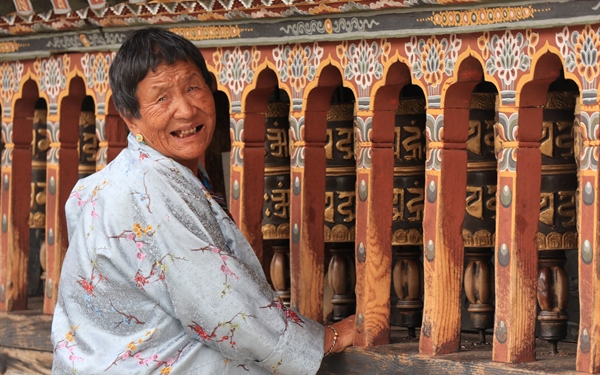
Photo: Daily Bhutan
How forests are part of GNH
Each of the variables in the GNH index has a role in supporting the four pillars of the mountainous kingdom’s development framework: good governance, sustainable socioeconomics, environmental conservation, and preservation and promotion of culture. Underpinning all of this, the country’s constitution calls for 60 percent forest cover in perpetuity. Forests are in the house.
My many visits to Bhutan – first to help set up a study-abroad program, then to collaborate on research – have made a deep impression on me. My interaction with Bhutan’s people, landscapes and cultural traditions, even their struggles with change, have fundamentally altered my outlook on life, and, indeed, it has boosted my own happiness. It must be the 71 percent forest cover!
While Bhutan’s own GNH index score is less than 1.0, and it is not ranked as the “happiest” nation on Earth, the values related to community, tradition, family, spirituality and environmental conservation that are reflected by the way people interact with each other, their landscapes and even visitors convey a sense of calm rarely found in other societies.
More than half of all Bhutanese people live in rural areas, with economies and primary rural livelihoods firmly based in the natural environment. Their housing, their faith, their furniture – and, dare I say, their happiness – are founded quite directly on the land’s precious natural resources, such as water, soil and forests.
While the 2015 GNH survey suggests that people residing in urban areas are happier than those in rural areas, the government nonetheless promotes incentives for people of all ages to make their way back to the rural areas, and particularly for the youth to base their livelihoods in agriculture, tourism, and diversified industries that will help re-populate rural areas – and happily so.
Impressed with Bhutan's concern for the environment
I am currently teaching a new course at Hampshire College, a small liberal arts college in the US, called “Knowing the Forest.” It is a survey of sorts, where students explore the ways we know the forest; the things we know about the forest; the ways we know ourselves in the forest; and the diversity of perspectives, experiences and dependencies related to forests. My goal is to foster student desire and courage to access a primal source of happiness: the forest.
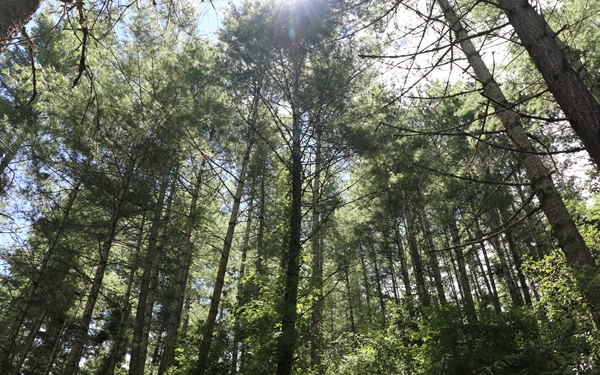
Photo: Daily Bhutan
Yet, I struggle to reconcile what I can teach in my corner of the world with what’s happening around the rest of the globe, and in Bhutan.
Delving into Bhutan’s GNH survey reports from 2010 and 2015, I was impressed with the concern for the environment. One variable in the index is “How well do you know the local plants and animals?” Knowledge of names was very high in 2015, with 78 percent indicating above-average knowledge, up from 65 percent in 2010. Are my students that knowledgeable?
In an effort to raise consciousness on the importance of nature to the well-being of the college community, my students and I are developing and implementing a Forest Stewardship Plan for our college’s 243 hectares of natural forest. I first thought to model it on the Massachusetts forest authority template for forest management plans, but after our first round of interviews with students, faculty and staff of the college, it became apparent that the college forest’s meaning to our community stretches far beyond its wildlife habitat, species diversity, soil types and other components included in the plan template.
Primarily, the college forest is collectively held as a source of happiness. It is a site where students and staff seek refuge, day after day, from the miasma of digital media, internal struggles of self-worth and college politics. “Mental health” emerged from interviews as the foremost social value of the forest.
Insects versus spirits
In Bhutan’s 2015 round of interviews for its GNH index, 84 percent of respondents said they believed that nature is the domain of spirits and deities. At the same time, one-quarter of the Bhutanese sample felt unsafe about the presence of ghosts in the neighborhood or village after dark. For my students, our forest is a place for play, freedom, wonder, curiosity, and they worry more about encountering unpleasant insects and people than spirits.
Happily, nearly the entire sample in the 2015 GNH survey (save for a heartless 0.7 percent) felt at least mildly responsible for environmental conservation, with 79 percent even feeling highly responsible. How much is environmental stewardship linked to spiritual belief, or emotional connection? How much is it motivated by ecological knowledge?
My students are concerned about the forest on campus, citing invasive plants dominating some understory areas, emerging pests and disease weakening and killing trees, and the lack of regeneration due to trampling and soil compaction from weekend “woods parties” in the red pine stand at the back boundary.
Disassociation from nature a recent phenomenon
On the evolutionary time scale, as Japanese forest therapy researcher Yoshifumi Miyazaki points out in his book Shinrin Yoku: The Japanese Art of Forest Bathing, human’s dissociation from nature is only quite recent. In today’s societies, in which people are highly removed from the outdoors, spending time in nature is now promoted as the antidote to depression, providing a source of connection to both ourselves and to something much bigger.
My course is that antidote. Bhutan’s promotion of knowledge of nature, responsibility for environmental stewardship and respect for the spiritual elements of nature is that antidote. I believe that if I can deepen the relationship of today’s youth with nature, I will have boosted the gross global happiness.
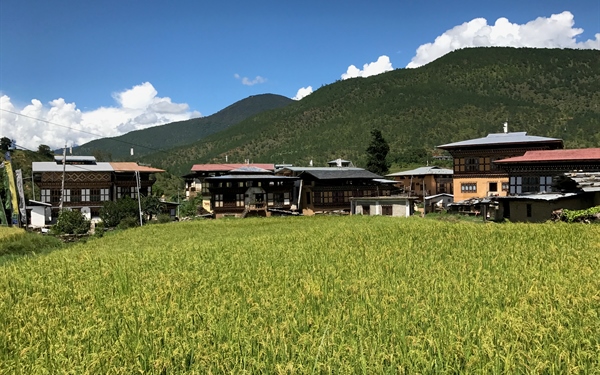
Photo: Daily Bhutan
I go into the forest because it makes me feel calm, content, creative – unlike hunters, honey farmers, cordyceps collectors, whose livelihoods depend on the forest. I am committed to use my privilege (or is it a curse?) of relative dissociation from nature to work for the environment so that we can all enjoy the many benefits of its existence.
After all, if there is no forest, I lose my work, my students lose their minds, Bhutanese lose their livelihoods and we all lose our happiness.
In the end, of course, our happiness comes from within, and we each must find our own equation. Mine most definitely includes variables related to the forested landscape.
By Dr. Robin R. Sears is a forest scientist and Charles Bullard Fellow at the Harvard University’s Harvard Forest.
This article was first published at Landscape News and has been edited for Daily Bhutan.