
Atsara: the Bhutanese clowns who are not just clowns
On top of being clowns, they are also storytellers, spiritual teachers, and the master of ceremony. The bright red mask and giant phallus hanging from their forehead speak to the level of enlightenment they have achieved.
What are Atsaras?
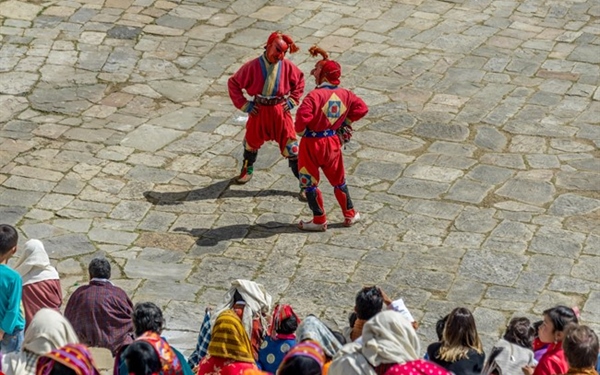
If you attend a Bhutanese tsechu, expect to see comical characters prancing around. They wear a red mask with a hawkish nose, a giant phallus hangs from their forehead. These are Atsaras.
Atsaras are synonymous with the tsechus.
The red mask symbolises burning passion, whereas the phallus represents power and fertility.
Atsaras embody the Buddhist principle of being open, jovial, and liberal. Their character vaguely reflects that of the Buddha, who has transcended the petty human dichotomy of like and dislikes; pain and pleasure; biases and fixations. The Atsara teaches us to look inwards and rise above our constricted surroundings.
The legend of the Atsara
The word ‘Atsara’ derives from the Sanskrit word ‘Acharya’, which means holy Indian master.
Atsaras are Dupthobs, enlightened beings who have realised the Samsaric truths. At this stage, they have risen above petty human emotions like shame, anger, desire, and likes. They do not live in want, and they do not covet.
Legend has it that Atsaras were among the Dupthob Gyabchu, the Buddha’s disciples. 84 Dupthobs, who had detached themselves from worldly desires and attachments, roamed the world, mocking worldly objects to overcome evil.
They dressed in colourful attires and had eccentric behaviour. Sometimes, they even used foul language in their quest to subdue evil in the minds of the mortals.
The Atsaras emanate these learned beings. Their vulgar forms send the message that they know no embarrassment, hesitation, or reservation.
Atsaras were initially known only in Trongsa and a few other places. The character gained acclaim when tshechus became popular under the reign of the second King, gaining popularity throughout Bhutan.
The role of the Atsaras
Some people think of them as clowns. While it is their job to entertain the crowd, and sometimes they do that with comedy, it is also their job to encourage the audience spiritually — to forget their burdens and unleash their free spirit.
In truth, a lot rests on the shoulders of the Atsaras.
They are also the master of ceremony as they perform crowd-control and ensure that the tsechu runs smoothly.
Ultimately, Atsaras are storytellers. They provide the background story during the mask dances.
The Atsaras have three main roles: External (Pchi), Internal (Nang), and Hidden (Sang).
Externally (Pchi), the Atsara aids the mask dancers in case of, say, a wardrobe malfunction, or if the dancers err in their dance steps. Regular people are not allowed to help them, and only the Atsaras may do so.
Internally (Nang), the Atsara translates the dances or chams for the lay audience. Some people might have trouble understanding them, so the Atsara explains the meaning to the audience. He clowns around to keep them entertained.
On the hidden level (Sang), the Atsara has achieved a level of enlightenment that he tries to pass down to those around him.
Not simply any Tom, Dick, or Harry can become an Atsara. The position is passed down through the lineage although nowadays, anyone who has performed all the mask dances may be considered for the role.
Over time, the role of the Atsaras has evolved. Present-day, their duties include educating the public on issues such as the importance of safe sex and personal hygiene.
At the end of the festival, the Ataras might collect tips from the audience to be shared with all the dancers and performers. A new rule dictates that the Atsaras are only allowed to ask for money on the last day of the tsechu.
Usually, there are a number of Atsaras, but only one plays the role of head Atsara.
Performance by the Atsaras
Curious about these enigmatic characters? Check out their comical antics in the video.
Do you wish to see an Atsara in real life?
If you do, visit a tsechu! Bhutan is known for their festivals, held all year round, but the tsechu in Bhutan is the most significant of them all. In fact, you may plan your trip to Bhutan according to which tsechu you wish to attend.
Tsechu literally means ‘tenth day’. It is celebrated on the tenth day of different months of the Bhutanese lunar calendar. The festival is meant to honour Guru Rinpoche, the saint who brought Buddhism to the country in the 8th century. For the Bhutanese, attending a tsechu is a religious move that brings them closer to enlightenment.
The tsechus are held in different temples and dzongs throughout the country at different times of the year.
Among the popular tsechus that you can visit to see an Atsara are:
January
- Trongsa Tshechu
- Lhuntse Tshechu
- Pemagatshel Tshechu
February
- Punakha Dromache & Tshechu
- Trashiyangtse Tsechu
March
- Talo Tshechu
- Zhemgang Tshechu
- Paro Tshechu
- Chuukha Tshechu
July
- Nimalung Tshechu
- Kurjey Tshechu
October
- Phuentsholing Tshechu
- Wangdue Tshechu
- Gangte Drubchen & Tshechu
- Gasa Tshechu
- Thimphu Tshechu
November
- Jakar Tshechu
- Mongar Tshechu
December
Nalakhar Tshechu