

Bhutan Earthquake Opens Doors to Geophysical Studies
A multinational research team discovered an underestimated earthquake hazard during their 7-year exploration of the unique geodynamics of the eastern Himalayas in Bhutan.
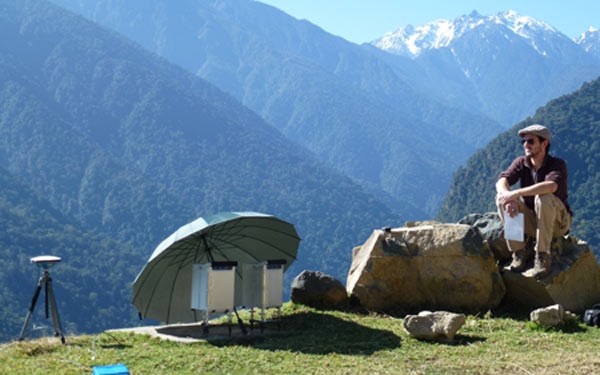 Research team member Théo Berthet monitors data collection during a campaign to a less visited region in central Bhutan. The Black Mountains, which rise to 4,500–4,600 meters, are visible in the background.
(Source: György Hetényi)
Research team member Théo Berthet monitors data collection during a campaign to a less visited region in central Bhutan. The Black Mountains, which rise to 4,500–4,600 meters, are visible in the background.
(Source: György Hetényi)
By
In 2015, a magnitude 7.8 earthquake shook the Gorkha District of Nepal, killing more than 9,000. The memory of this event is still vivid for the residents of this central Himalayan nation.
But farther east in the mountains, in Bhutan, many residents doubt the likelihood of a similar event happening to them. Bhutan had experienced several other earthquakes with a magnitude of about 6 during the past century. However, there was no clear evidence that Bhutan had ever seen an earthquake similar to the M7.8 Nepal event.
Findings from recent geophysical exploration suggest that this confidence may be overly optimistic. These results have shown that the eastern Himalayas region is extremely complex compared with the rest of the mountain belt.
The kingdom of Bhutan sets great store in its traditions and its principle of Gross National Happiness. Although its rugged terrain and remote location have allowed this kingdom to preserve its unique culture, these factors have also limited the development of international collaborations there, notably in the Earth sciences. This situation changed in 2009 after a damaging M6.1 earthquake that claimed 11 lives persuaded Bhutan to open its doors to exploration of the region’s geophysics.
Our team studied mountain-building processes in this region after the 2009 earthquake. After 7 years of multipronged field campaigns, we learned that Bhutan’s geodynamics are as unique as its culture. The region’s crustal structure, seismicity, and deformation pattern are all different from what scientists had speculated previously.
During our campaigns, we found evidence that at least one M8 earthquake had, in fact, occurred in Bhutan. This means that other earthquakes of this magnitude could occur in the region again.
A different plate?
Although the western and central Himalayan arc curves gently from Pakistan to Sikkim and has a low-lying foreland, the eastern third curves more sharply and has significant topographical relief south of the mountain belt, namely, the Shillong Plateau and neighboring hills (Fig. 1).
Previous studies proposed that these structures accommodate part of the India-Eurasia tectonic plate convergence. These earlier studies also proposed that the great 1897 Assam earthquake (M8.1) had relieved some of the strain between these converging tectonic plates, thereby lowering earthquake hazard in Bhutan.
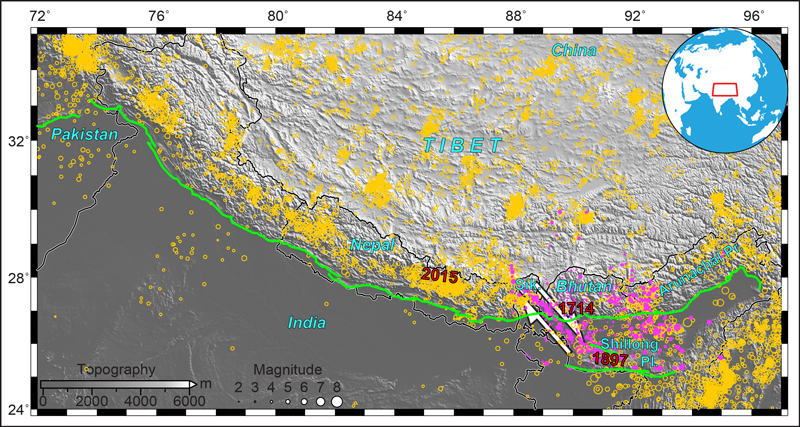
Fig. 1. Topographic map of the 2,500-kilometer-long Himalayan arc and surrounding region, with formerly (yellow) and newly (pink) cataloged seismicity. The dextral fault zone (white arrows) between Sikkim and the Shillong Plateau marks the break of the India plate, east of which a zone of complex 3-D deformation begins. Red dates mark the three largest earthquakes mentioned in the text. Green lines mark the surface trace of the megathrust along which the India plate underthrusts the Himalayan orogen, as well as the thrust faults bounding the Shillong Plateau. Political boundaries are shown for reference. Abbreviations: Pl. = plateau; Pr. = Pradesh; Sik. = Sikkim. (Source: EOS)
We collected new gravity, geodetic, and seismology data, and we found that the lithosphere—the rigid top layer of Earth—beneath Bhutan and the Shillong Plateau is most likely not part of the Indian plate or, if it once was, that it is now detached from it. The demarcation between plates stretches in a NW–SE direction, without a surface trace, but it is evident in a middle to lower crustal zone of continuously active seismicity and dextral (right-lateral) motion. This fault zone most likely hosted an M7 earthquake in 1930.
Our GPS measurements confirm the relative motion of the newly defined microplate. These measurements also show that this microplate is rotating clockwise with respect to the Indian plate. The different behaviors of the two lithospheres are clearly expressed in their differences in flexural stiffness along the strike direction of the orogen (mountain belt). The flexural stiffness beneath Nepal is homogeneous but is comparatively weaker beneath Bhutan.
A similar, but less well defined, deep seismicity zone, with distinct GPS vectors and flexural signatures, may mark another terrain boundary farther east along the Himalayas in Arunachal Pradesh.
Not a safe haven
India’s 1897 Assam earthquake, which occurred farther south, is only a few human generations in the past and has not completely faded from memory. No event since then has reached magnitude 7 in Bhutan, and many of the local population believe that big earthquakes cannot happen there.
However, the return period of large Himalayan events is longer than oral history: Western Nepal, for example, has not experienced a significant event since 1505. It is true that over the past decades, the seismicity rate in Bhutan has been low, but we have found evidence of several great earthquakes in the past on the local megathrust.
Geomorphological analysis of uplifted river terraces in central Bhutan revealed two major events over the past millennium. A newly excavated paleoseismological trench has documented surface rupture during a medieval event and a 17th–18th century event. Calculations based on newly translated historical eyewitness reports, macroseismic information, and reassessed damage reports have constrained a M8 ± 0.5 earthquake on 4 May 1714.
Thus, the seismic gap proved to be an information gap: The entire length of the Himalayas can generate earthquakes with a magnitude greater than 7.5, and it has done so in the past 500 years.
Differences at multiple scales
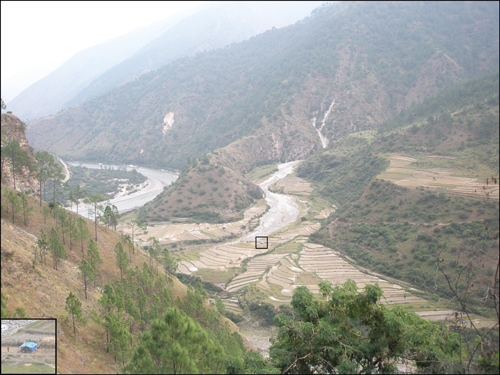
The landscape in eastern Bhutan, south of Trashigang, typically features incised valleys, steep slopes, and terraces. The hut in the center is shown in the inset for scale. The view here is to the east, and the hut is located at 27.2784°N, 91.4478°E. (Source: György Hetényi)
The major change along the Himalayas occurs between their central western part (with a single convergence zone) and the eastern third (with distributed deformation including strike-slip motion), and the east–west extent of Bhutan exhibits even greater complexity. The crust appears to be smoothly descending in western Bhutan and is subhorizontal in the eastern part of the country. Our measurements of seismic wave speeds in the upper crust show important changes across the country, and they coincide well with the geological structure mapped at the surface.
The most striking difference between western and eastern Bhutan is the crustal deformation pattern. In the west, the accommodation of present-day crustal shortening is very similar to the rest of the Himalayas: The plates in the megathrust region are fully locked, and microseismicity (the occurrence of small events) is scattered across the crust. In the east, the locked segment of the megathrust is shorter, and it focuses most of the microseismic activity within a smaller region. Also, the fault appears to be creeping (sliding without producing significant seismicity) in both shallower and deeper segments.
This variation of loading and background seismicity warrants further research along the entire Himalayan orogen because there is very little existing insight into variations of structures and processes at such short distance scales.
Gangkhar Puensum, a mountain in north central Bhutan, is clearly visible from the main road between Ura and Sengor, looking north-northwest. Gangkhar Puensum, at an altitude of 7,570 meters, is the highest unclimbed peak on Earth. For religious reasons, mountaineering above 6,000 meters is prohibited in Bhutan, so this record is very likely to remain. (Source: György Hetényi)
Bhutan is moving forward
Bhutan is an exotic place that has self-imposed isolation for a long time, but the country’s technology is now catching up at a rate that is higher than for the rest of the Himalayan regions. During our 2010 campaign, we used paper traveler’s checks, and we lacked individual cell phones. During our 2017 campaign, we had access to automated teller machines (ATMs) and 3G internet.
Likewise, our seven years of field campaigns in this region have advanced our geophysical exploration and geodynamic understanding considerably. Still, there is a strong need to continue and build on the existing knowledge, which includes freely available seismological, gravity, and GPS data from our projects.
Focusing on three areas would help improve future development in Bhutan:
- Broadening timescales. Acquiring long-term data needed to confirm or to adjust interpretations made on relatively short timescales is possible only with national observatories. We have launched seismology and GPS monitoring initiatives, and we hope for long-term funding and training of local manpower for all levels of operation.
- Broadening investigations. Some fields of study have advanced dramatically, including work on glacial lake outburst floods and on landslides. Others, like seismic microzonation, have been limited so far and could benefit from more extensive efforts. There is also a strong need for up-to-date building codes that reflect the scientific knowledge coming from these investigations.
- Increasing public awareness of natural hazards. The Bhutanese Ministry of Home and Cultural Affairs now has a full department devoted to disaster management that includes well-trained employees and comprehensive administration. However, education is the key to reaching the broadest population possible, which requires regular adaptation of school curricula and concise, practical information that local residents from any generation can understand.
We hope that recent efforts by our teams have promoted progress in the right direction. We also hope that large portions of the population will be sufficiently aware to deal with the next natural disaster. As our research shows, the next event may come sooner than previously thought.
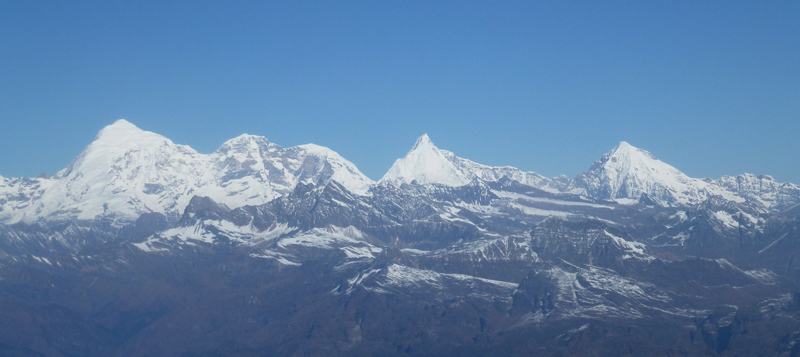
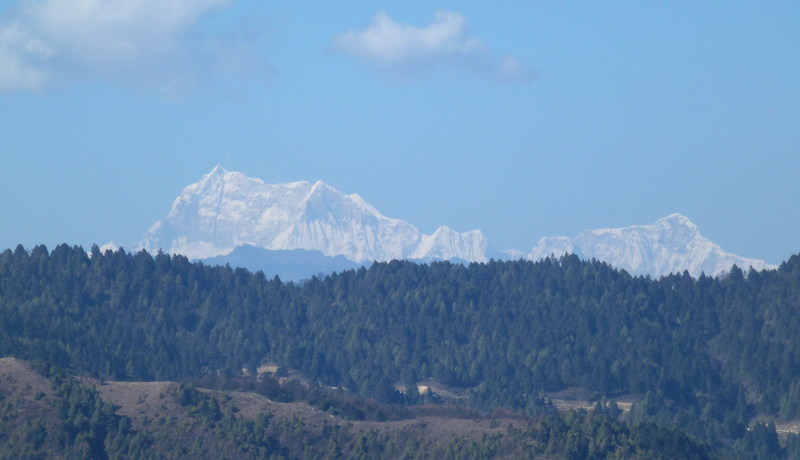
The main Himalayan peaks in northwest Bhutan, on the border with southern Tibet, are, from left to right, Chomolhari, Jichu Drake, and Tserim Kang. Exact altitudes are debated, but Chomolhari is higher than 7,000 meters, and Tserim Kang towers above 6,500 meters. (Source: György Hetényi)
The article first appeared in EOS and has been edited for the Daily Bhutan.