
The popular mythical animals in Bhutan: Dragon, Garuda, Snow Lion, Tiger, Windhorse, Takin, Raven, Yeti
Whether imaginary or real, animals are a recurring symbolic element of ancient Bhutanese art and spirituality.
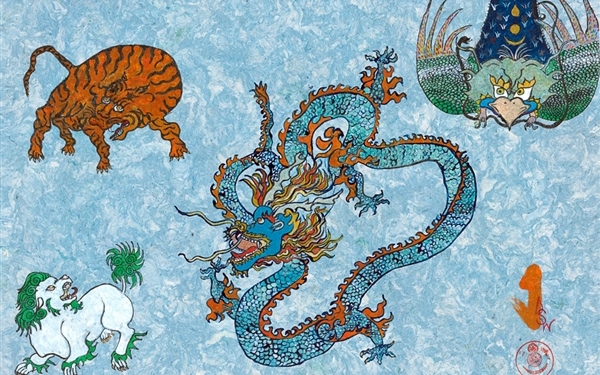
The symbolism of animals contains a wealth of meaning in both social and religious contexts. The rich and varied animal motifs in Bhutanese culture can be divided into three major categories, each with symbolic connotations: domestic animals, wild animals, and mythical creatures.
Below are some of the fascinating stories associated with some of the popular animals in the kingdom of Bhutan. Namely, the four mythical animals: Tiger (Tak), Snow Lion (Seng), Garuda (Chung) and Dragon (Druk), as well as the Takin, Raven, and the elusive Migoi (yeti).
About the four mythical animals
There are Four Mythical Creatures, also known in other names as ‘Four Guardians’, ‘Four Gods’, ‘Four Dignities’, or ‘Four Auspicious Beasts’ in Buddhist mythology. In Buddhism, the four guardian animals, Garuda, Dragon, Snow Lion and Tiger symbolise the overcoming of birth, old age, illness and death. They are also known as the guardians of the four cardinal directions: north, south, east and west.
These mythical animals also represent the sacred qualities and attitudes that Bodhisattvas develop on the path to enlightenment - qualities such as awareness, vast vision, confidence, joy, humility and power.
Garuda represents fearlessness, power and wisdom
Dragon represents elegance, generosity, calmness and achievements
Snow Lion represents vitality, dignity, lightness and purity
Tiger represents confidence, discipline and modesty
Colourful wooden masks depicting these four animals are also worn by monks during the popular Tshechu festivals in Bhutan. These masks often have an enraged or menacing look but they don’t symbolise demons. In order to strike terror into evil spirits and to chase them away, the more terrifying the masks, the better they will keep evil spirits away.
These four dignities can also be found on the lungta, Buddhist prayer flags.
Garuda (Chung)
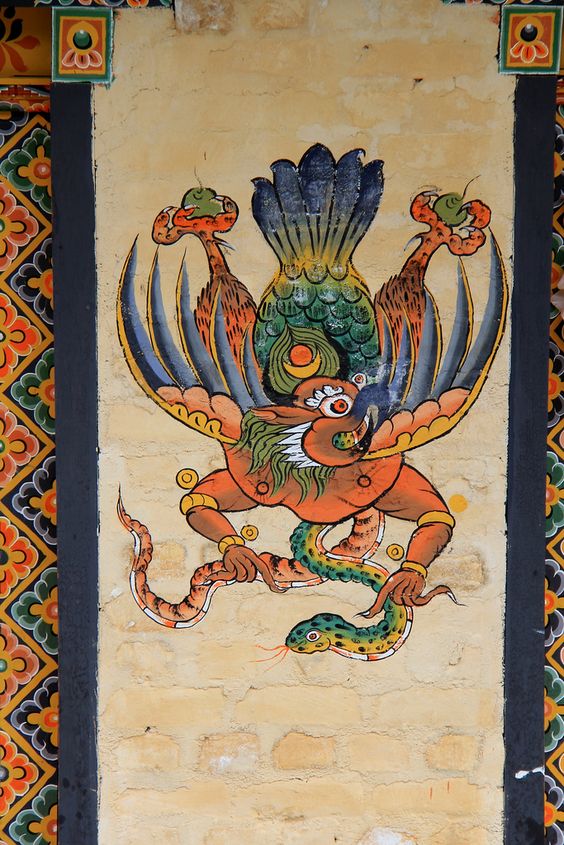
Garuda is a mythical semi-divine bird-like creature that is the enemy of the nagas (serpents). It is represented in both Hindu and Buddhist traditions. Garuda appears in many tales recounting the Buddha’s previous lives. In Vajrayana tradition, the garuda is associated with khyung (horned eagle), which is an important deity of the Bon religion. Garuda is generally a protector with the power to swiftly go anywhere and is ever watchful.
Garuda is one of the ‘Four Dignities’ representing fearlessness of the windhorse energy. He is believed to nest in the wish-fulfilling tree of life and unlike other birds, he is fully developed inside the egg. At the moment of hatching, he is immediately able to soar, unhindered, in vast and open skies. This symbolises our true nature, free from all limitations, perfected from the very beginning of birth. The garuda also represents the perfect realisation or awakened mind of a Buddha.
Garuda is often depicted holding a snake in his mouth and hands. It shows his ability in overcoming the nagas. In certain Nyingma teachings, he is seen as a keeper or protector of hidden treasures and sometimes viewed as the manifestation of Padmasambhava, ‘Guru Rinpoche’, the founder of Tibetan Buddhism.
Garudas are common subjects of Buddhist and folk art throughout Asia. Statues of garudas often serve to ‘protect’ temples. You can also find Garudas in India, Bhutan, Nepal, Indonesia, Thailand and Mongolia. Garuda is also the national symbol of Thailand and Indonesia.
Dragon (Druk)
Among all legendary creatures, the dragons have taken their unique place among the pedestals of mythological accounts as well as present-day popular culture. And interestingly, dragons have been symbolic fixtures from a myriad of regions across the world.
As one of the four mythical creatures, Dragon represents power. The dragon thunders in the sky with the sound of compassion that awakens us from delusion and increases what we know through hearing. Thus, it can be said that dragons bring forth our awareness to things that we cannot see.
Bhutan, often referred to as Druk Yul, or the Land of the Thunder Dragon takes its name from the druk or the Thunder Dragon, a mythical animal revered by the Bhutanese as the symbolic guardian of the country. It’s the national personification of Bhutanese culture, mythology and monarchy. The dragon is prominently featured in Bhutan’s national anthem (Druk tsendhen) and national flag. The dragon is snarling and clutches jewels in its claws. The jewels in the dragon’s claws represent the wealth and prosperity of Bhutan. The snarling dragon represents the male and female deities who are always protecting the country, its King and the people from harm or outside forces that are threatening them.
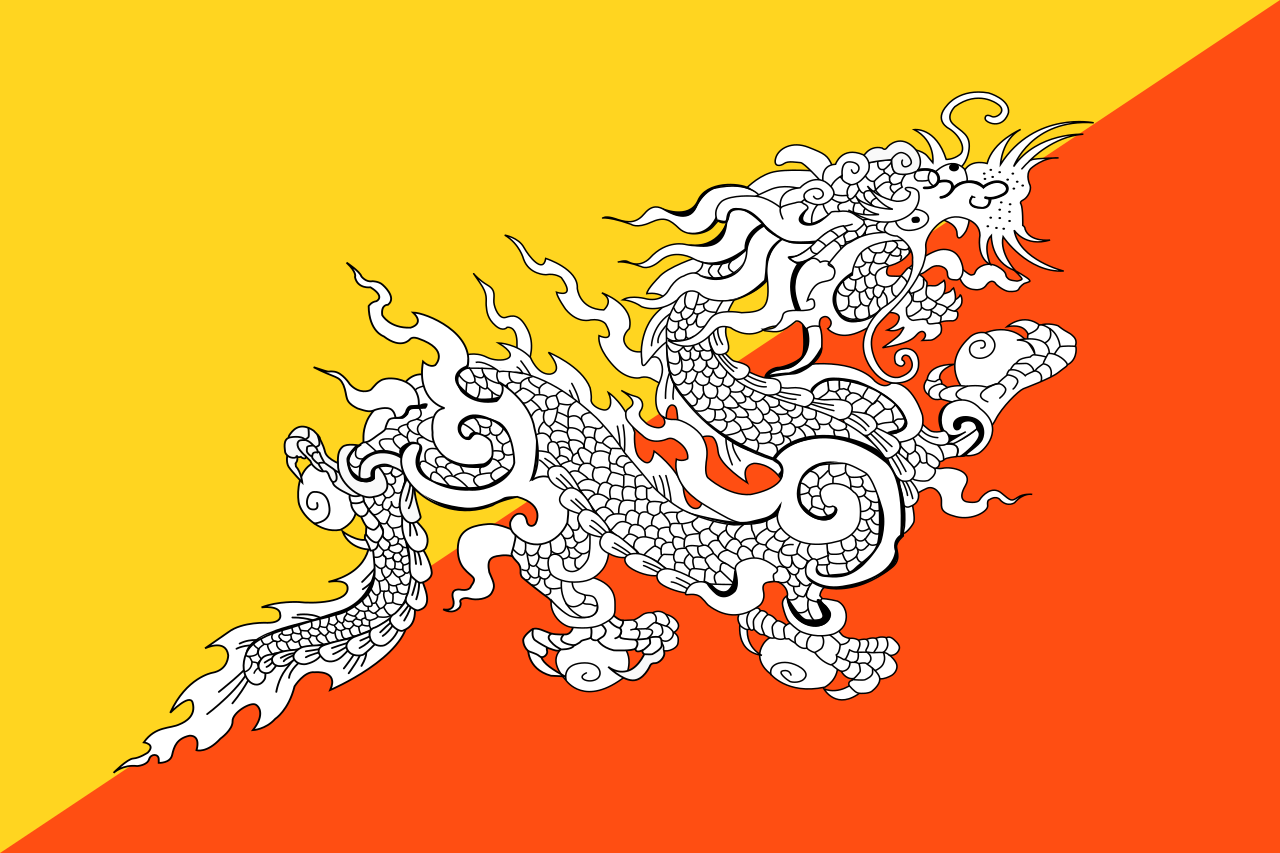
The titles of the leaders of Bhutan are also associated with the mythical dragons. The kings of Bhutan are addressed as Druk Gyalpo or ‘Thunder Dragon Kings’. Even all the political parties were named as ‘Druk Party’, for a mock election that was held in 2008.
On how Bhutan got its name, legend has it that Tsangpa Gyare, a renowned meditation master and ancestor of Bhutan’s founding father, Zhabdrung Ngawang Namgyel, was visiting the Nam village to set up a spiritual centre. When he was there, he is reported to have seen nine dragons. They flew off as he was approaching, triggering a booming clap of thunder in the sky.
Tsangpa Gyare read these as auspicious omens for the founding of his centre, and thus named the place Druk. His tradition also took the derivative name Drukpa, the state religion in Bhutan.
Snow Lion (Seng)
Not to be confused with the snow leopards, rare and endangered animals living in the Himalayas, snow lions are mythical animals. Snow lions are represented in Buddhism as the support and protector of Buddha.
The lion, as the king of all beasts, is an ancient Indian symbol of sovereignty and protection. The lion in Indian art is represented in Tibetan buddhist art as the Snow Lion. Early Buddhism adopted the lion as a symbol of Shakyamuni Buddha. As a symbol of his sovereignty, the Buddha is seated upon the throne supported by eight snow lions representing the eight Bodhisattvas disciples.
Thus, the Snow Lion is the protector of Buddha, and it is usually seen holding up the Buddha's throne (one on the left and one on the right of the throne) in paintings and sculptures. Lion is also depicted as a vehicle for a number of Vajrayana deities such as Vaishravana, Manjushri, Ganapati and Tashi Tseringma.
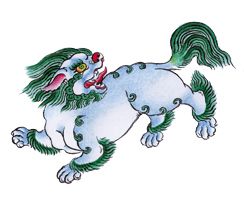
The body of the Snow Lion is white while its flowing mane, tail and curls on legs are usually blue or green. While most Snow Lions are gender neutral in Buddhist art, there are some that are represented as obviously male or female. When represented as a symmetrical pair, the male is on the left and the female on the right. The snow lion is often associated with youthfulness, vibrant energy of goodness and cheerfulness.
Snow lions are often depicted in Tibetan paintings, sculptures, folk songs and proverbs. In fact, the Tibetan national flag is known as the ‘Snow Lion flag’. There is a pair of snow lions blazing with the manes of fearlessness, which represent the country’s victorious accomplishment of a unified spiritual and secular life.
Tiger (Tak)
The tiger is one of the four mythical animals associated with the Kagyu lineages of Tibetan Buddhism. Bodhisattva Vajrapani wears the skin of a tiger and sworn dharma protectors such as Mahakala, follow in this tradition that combines yogic symbolism with the buddhist values.
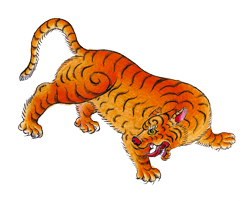
In Tibetan Buddhism, the tiger symbolises awareness, kindness and confidence. Such qualities are considered necessary for the practice of the Buddhists walking the sacred path. In Vajrayana tradition, several deities are represented riding a tiger, especially wrathful emanations. In this case the tiger symbolises the power to overcome fear, desire and ignorance
One of the most popular legends is about Guru Padmasambhava, also known as Guru Rinpoche, who flew to the most iconic site of Bhutan, Taktsang Monastery, on the back of a tigress in a wrathful form (Dorji Drolo). Thus, that is how the sacred site located in Paro valley got its name, ‘Tiger’s Nest’. It is also believed that the tigress was actually the transformed eminence of the Guru Rinpoche’s female consort, Yeshe Tsogyal.
A more subtle symbolism of tiger has to do with Tantric Buddhism. Historically, Tiger skins were a favoured meditational mat for Tantric sages. In Tantric Buddhism, the tiger skin represents transmutation of anger into wisdom and insight, it also offers protection to the meditator from outside harm.
Wind horse (Lung ta)
The Wind Horse is a mythical creature from pre-Buddhist times. However, while the original concept of lung ta bears no relation to Buddhism, over the centuries it became more common for Buddhist elements to be incorporated. In Tibetan Buddhism, it was included as the pivotal element in the center of the ‘Four Dignities’: Garuda, Tiger, Snow Lion and Dragon. It is the uplifting energy that carries good fortune to all sentient beings.
The wind horse is typically shown without wings but carries the Three Jewels or the wish-fulfilling jewel. Its appearance is supposed to bring peace, wealth, and harmony. The prayer flags themselves are known as windhorse, ‘lung ta’. When they flutter in the wind, they carry the prayers from earth to heavens like the horse flying in the wind.
Surrounding the Lung Ta are various versions of mantras, each dedicated to a particular deity. In addition to mantras, prayers for a long life of good fortune are often included for the person who hang the flags.
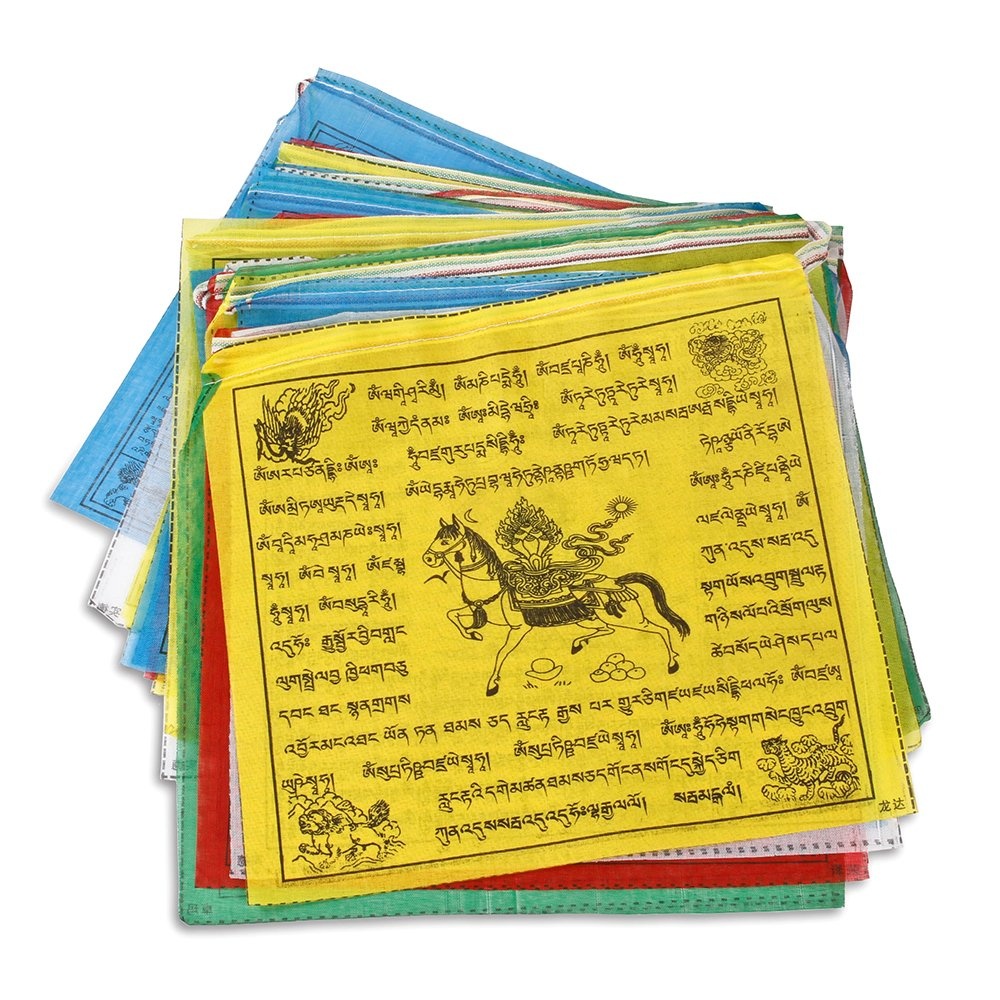
You can purchase Lung Ta from Bhutan Natural online store.
Takin (Budocas Taxicolor)
The Takin (Budocas Taxicolor) is a queer looking animal that looks like a hybrid of cow and goat.
Taxonomists call it a “goat antelope” and others call it a “gnu goat”. The takin found in Bhutan is one of the four subspecies of takins found in Asia. The Bhutan takin is an endangered species and was declared the national animal of Bhutan on 25 November 2005.
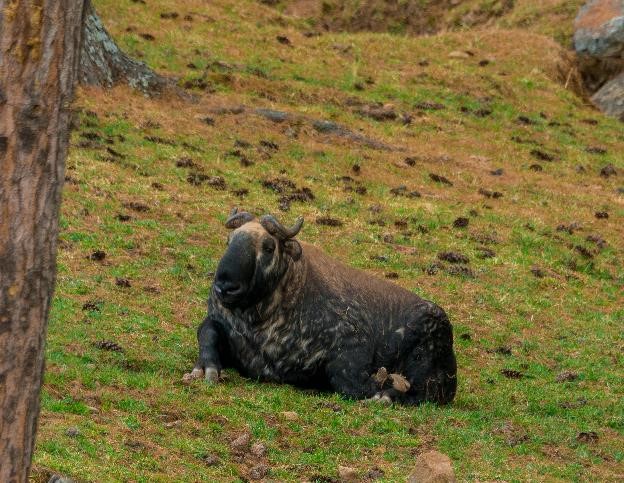
There is also an interesting myth about the creation of Takin. Legend has it that when Lam Drukpa Kunley, popularly known as the ‘Divine Madman’, arrived in Bhutan from Tibet, in the 15th century, the locals requested for him to conjure up a miracle at the end of a feast. During the feast, he was fed a whole cow and a whole goat. After devouring the flesh of both animals and left with the bones, he fixed the head of the goat onto the body of the cow and with a snap of his fingers, created a new animal and named it ‘Dong Gyem Tsey’ (Takin).
You can see takins by visiting the Motithang Takin Preserve in Thimphu. Originally a mini zoo, it was converted into a preserve when it discovered that the animals refused to inhabit the surrounding forest even when set free. Given that the takins had become domesticated, a decision was made to keep them in an enclosed, forested habitat at the edge of Thimphu. An area of 3.4 hectares (8.4 acres) was demarcated and fenced for the preserve.
Raven (Legon Jarog Donchen)
The Raven is the world’s largest species of black birds and the raven (Corvus Corax Tibetanus) is the national bird of Bhutan. The raven signifies one of the most powerful deities of the country.
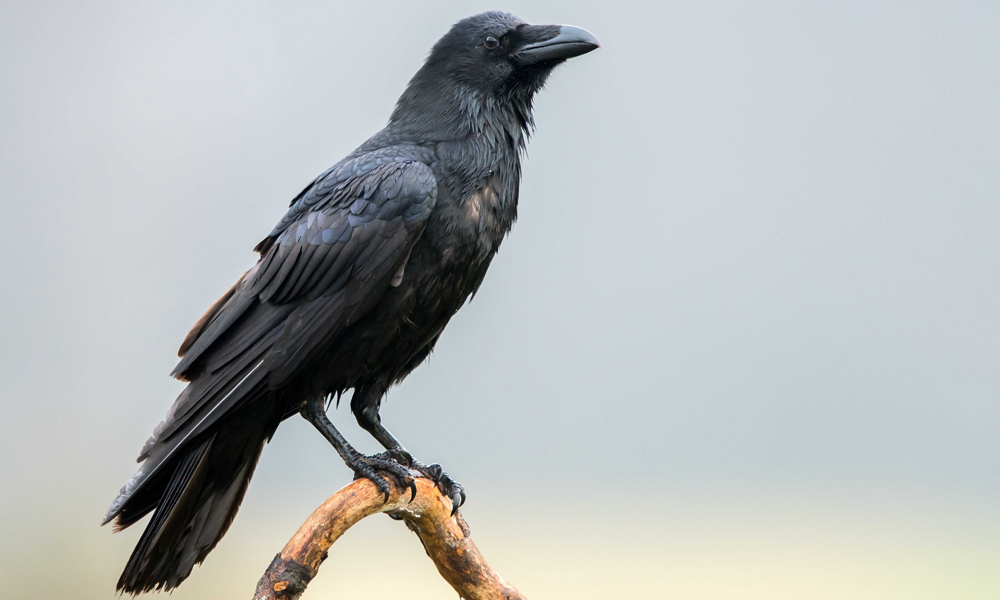
Its shining black feathers, distinctive voice, and playful nature represent power, mystery, wisdom, and intelligence. Known in Bhutan as Legon Jarog Donchen, the raven is seen as an emanation of Mahakala, the wrathful protective deity. It is believed that the guardian deity took the form of a raven to guide the country’s unifier, Zhabdrung Ngawang Namgyel in his trip to Bhutan from Tibet in the 17th century. As the nation’s protector, the raven is considered so sacred that killing a single raven is one of the most heinous crimes.
The first king of Bhutan, Ugyen Wangchuck, was a charismatic figure, adopted a crown with the head of a raven as the unique symbol of his authority and the crown came to be known as the Raven Crown. The first Raven Crown was worn as a battle helmet by his father, Jigme Namgyel, during wars with the rivals including the British in 1885. Known as the Black Regent, Jigme Namgyel emerged victorious and could not be defeated by the mighty British. The Raven’s head denoting the guardian deity of Bhutan was believed to have helped him through all these wars and thus, the Raven Crown today is the official crown worn by the kings of Bhutan.
Yeti (Migoi)
Yeti or locally known as ‘migoi’, is a large ape-like creature that has been spotted everywhere from India and Nepal to Bhutan and Tibet. The Yeti (‘man-bear’, ‘abominable snowman’, ‘wild man’ or ‘strong man’) has been part of Himalayan folklore for centuries. The migoi is known for its phenomenal strength and magical powers, such as the ability to become invisible and to walk backwards to fool any trackers.
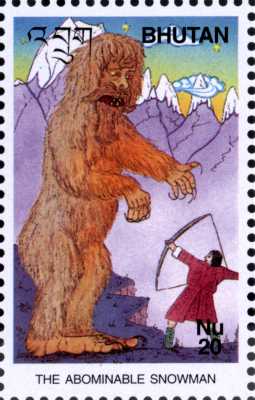
There is no scientific proof confirming the presence of this mythical creature, but folklore and urban legends about the yeti in local Bhutanese culture still exist and many people insist that there have been sightings of migoi in the Sakteng region.
While it is common for most countries to create sanctuaries to protect their landscape and wildlife, only Bhutan would create a wildlife sanctuary for a mythical creature whose existence has no hard evidence but has an important place in local belief and folklore. Sakteng Wildlife Sanctuary in eastern Bhutan was partly created in part to protect the migoi. Thus, the yetis have their own wildlife sanctuary, living among blue pines and rhododendrons.
To visualise how a yeti looks like, here are the extracts from ‘Bhutanese Tales of Yeti’ by Kunzang Choden:
"The migoi is known by all accounts to be a very large biped; sometimes as big as 'one and a half yaks' or occasionally as 'big as two yaks'. It is covered in hair that ranges from reddish brown to grey black. Its limbs are ape-like and its face generally hairless.
The female has breasts that sag. They are usually encountered alone or as couples but rarely in groups. We are told they communicate with each other by whistling and they exude an exceedingly foul odour.
"On occasions they have been known to grin menacingly and make strange noises; they are said to indulge in mimicry. This aspect of their character has given rise to many tales and legends. It is generally agreed that encountering them is a bad omen, which leads to misfortune and even death in some cases."
Yeti or no yeti, this legendary creature is here to stay for many more generations.