
The Moving Mandala: Inside Bhutan's Sacred Dance Festivals
At the annual events, monks perform cham, choreographed rituals that serve as enlightening visualizations and honor the influential guru who danced them.
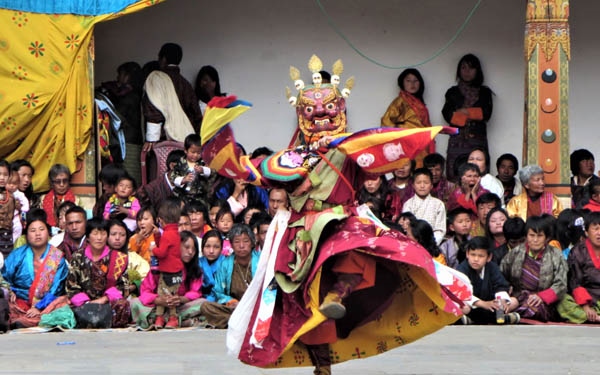 A cham practitioner embodying the wrathful incarnation Dorje Droloe enters the dance space during the tshechu [sacred festival] in Punakha, Bhutan.
(Source: Karen Greenspan)
A cham practitioner embodying the wrathful incarnation Dorje Droloe enters the dance space during the tshechu [sacred festival] in Punakha, Bhutan.
(Source: Karen Greenspan)
By Karen Greenspan | Tricycle
In the world of Himalayan Buddhism, there is hardly anyone of greater influence than Padmasambhava, whom Buddhists of the region consider to be the “Second Buddha.” This great tantric practitioner, also called Guru Rinpoche, is well-known for bringing Buddhism from India to Tibet and Bhutan in the eighth century. It is not as well known that he was also a master of dance—or let’s just say a demonstrative, embodied form of spiritual practice we can recognize as dance.
The “out of the box” practices of tantric Buddhism, or Vajrayana, meant to accelerate a person’s path to enlightenment, emerged in India between 500 and 1000 CE and moved with Padmasambhava to the Himalayas. There, they incorporated elements of the shamanistic animism native to the area. This influenced the profusion of multi-sensory Vajrayana practices, including the sacred dances called cham, which are still performed today.
Purpose of cham dances
These dances are considered mandalas—embodied representations of a perfect universe—complete with their associated divine inhabitants. The cham dancers replicate, through movement and spatial design, the action and qualities of the deities that are visualized and meditated upon by Vajrayana practitioners, who hope to cultivate the deities’ enlightened qualities within themselves. Thus, the cham are three-dimensional animations of the sacred construction project of the mind carried out in the visualizations. For the viewer, cham is considered thongdrel—liberation through seeing—capable of generating enlightened qualities merely through the viewing of it.
In honor of Guru Rinpoche
In Bhutan, the culture is abound with references to Guru Rinpoche’s travels through the region and how he miraculously overcame obstacles to the new Buddhist religion in the Himalayan lands. Many of the guru’s incredible feats were believed to have been accomplished through the performance of cham. Today, most localities celebrate an annual tshechu, or sacred festival in the guru’s honor. “Tshechu,” meaning “tenth day,” refers to Padmasambhava’s promise, as he was departing his earthly existence, to return on the tenth day of each lunar calendar month to dispel the suffering of the people. The Bhutanese bring about his “return” through their tshechus honoring the guru’s teachings and activities through the performance of sacred and folk dances as well as Buddhist rituals. Many of the tshechu dances are understood to be the very dances that Guru Rinpoche performed as he overcame threatening obstacles and converted enemies into protectors of the dharma.

The monk dancers in Trongsa, Bhutan, rehearse the Guru Tshengye Cham, a two-hour dance of Guru Rinpoche’s eight manifestations. (Photo: Karen Greenspan)
On a recent trip to Bhutan, I traveled to Trongsa, a majestic mountainside village, to witness an annual tshechu. The festival is held in the town’s imposing dzong, a medieval fortress complex, built in 1644. I arrived a couple of days before the event to observe rehearsals and interview some of the dancers. The stone courtyard of Trongsa Dzong was filled with the swirl of red- and wine-colored robes as the monk dancers rehearsed several cham. Sixteen of the senior dancers were rehearsing Guru Tshengye Cham, a two-hour dance of Guru Rinpoche’s eight manifestations. He manifested in these eight forms to meet the demands of the moment, like a spiritual superhero. The eight manifestations rendered in Guru Tshengye Cham are the guru’s most famous forms, although many more have been enumerated in over two dozen sacred biographies (see below).
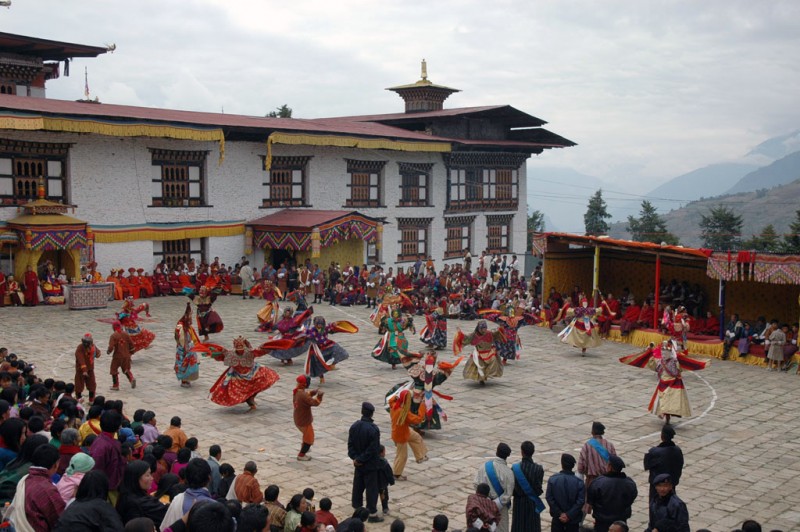
Guru Tshengye is considered one of the most sacred dances and is usually performed on the final day of the festival. (Photo: Bhutan Cultural Atlas)
"Treasure dance"
This cham is a revealed treasure dance, or tercham, taken from scriptures discovered by the great Tibetan terton [treasure revealer] Guru Chokyi Wangchuk, popularly known as Guru Chowang (1212–1270). Revealed treasures, or terma, are understood to be Padmasambhava’s teachings, which he and his disciples hid throughout the landscape or in the mindstream of chosen persons for discovery in the future when the times called for them. Many of the treasure dances are derived from what are believed to be treasure texts discovered in rocks, caves, and lakes; others came in the form of choreographic visions. As part of the treasure tradition, all of these dances are considered the sacred wisdom of Padmasambhava.
The sound of droning oboes builds a sense of expectation in the crowd as the Guru Tshengye dance opens with the wrathful manifestation, Dorje Droloe, taking possession of the ground. In a spiritual culture that inherited a host of easily offended pre-Buddhist spirits of the landscape, Vajrayana adopted ritualized methods for demarcating and cleansing sacred ground before a religious event. This may involve meditation, walking the perimeter of the performance ground, reciting mantra, dispensing offerings, and/or the offering of torma [ritual, multi-colored, sculpted forms made of flour and butter by monks].
Dorje Droloe performs a series of ceremonial high marching steps crossing the dance space back and forth with arms uplifted, holding the ritual scepter in one hand and the dagger in the other. Usually danced by the champon[dance master], Dorje Droloe acts as the master of ceremonies. He goes on to lead a formal circular procession in which the fully enlightened Guru Pema Jungney (actually a ninth manifestation portrayed by a master lama), dressed in fine robes and wearing a golden mask, is paraded to his throne in grand style—with ornamental parasol, musicians, and a full entourage. Meanwhile, Dorje Droloe and the other Guru Rinpoche emanations, along with a retinue of wrathful deities, continue to dance in a wide circle spinning back and forth.
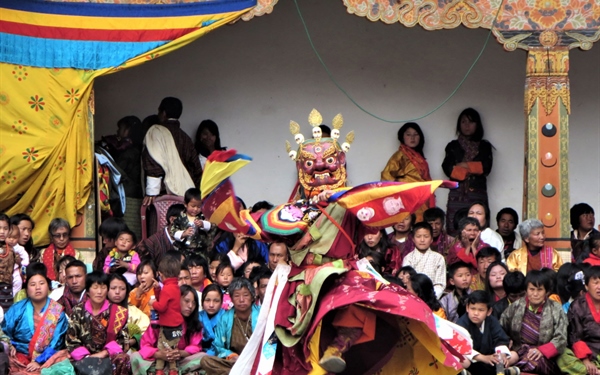
A cham practitioner embodying the wrathful incarnation Dorje Droloe enters the dance space during the tshechu [sacred festival] in Punakha, Bhutan. (Photo: Karen Greenspan)
Eight monks take turns dancing into the center of the circle performing solos representing each manifestation. These danced solos are not pantomimed or dramatized, but are distinguished mainly through their striking masks and costumes and less so through the choreography. The peaceful manifestations dance with deliberate majesty while the wrathful manifestations dance with building energy and speed. Meanwhile, the dancers remaining in the wide circle mirror the movements of the featured soloist and intone praises to each specific form of the guru.
Cham within a cham: Dance of the Sixteen Dakinis
Once the eight manifestations complete their dance and exit the courtyard, another cham is introduced into the larger dance—Dance of the Sixteen Dakinis [female wisdom facilitators], or Rigma Chudruk Cham. It is a cham within the cham. The dance is performed as an offering to Padmasambhava. The sixteen dancers sing and dance the offering of pleasing gifts (flowers, incense, butter lamps, perfume, ornaments, and so on). For this dance, young slender monks are costumed to look like dakinis in long brocade dresses overlaid with aprons of carved bone latticework. These spiritual guides dance unmasked wearing wigs of long black hair with a crown of five golden lobes. Their dance movements are slow, serene, and purposeful, featuring continuous, flowing arm motions and complex mudras [hand gestures] that symbolize the specific offerings to the guru. They look as if they are speaking a sign language.
During the tshechu, while the monks are performing these dances, the entire crowd of festival attendees lines up at varying times in an unhurried manner to receive blessings, holy water, and a prayer cord from the guru and his attending monks. People visit with family or friends as they wait in line and feel quite pleased at having the opportunity to be blessed. At this point, performance and real-life merge as the audience members enter the performance space to interact with the performers in their roles as enlightened beings, and the performance becomes a real-life ritual event.
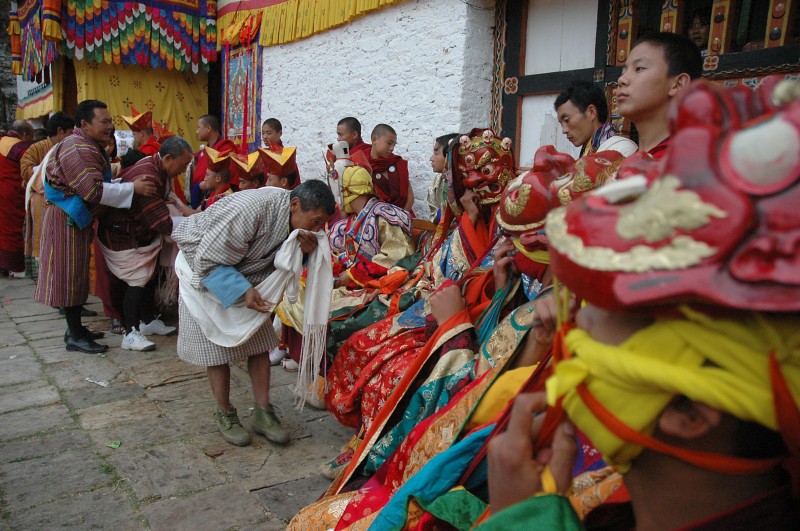
Blessings received during the Guru Tshengye have immense significance for most Bhutanese. (Photo: Bhutan Cultural Atlas)
As the dakinis complete their dance, the guru’s entourage of wrathful deities comes swirling into the dance space, leading another circular procession followed by Guru Rinpoche, his eight manifestations, monks, local officials, folk dancers, the incense carrier, and the musicians. The dakinis bring up the rear, continuing their flowing choreography. It seems like everyone gets in on the action as the oboes, dungchen [long telescoping horns], bells, cymbals, drums, and chanting fill the air with the sounds and sights of Vajrayana Buddhism.
Through the Guru Tshengye Cham, the Bhutanese recreate a mandala—a vision of a perfect universe—and place themselves in it. They join in the company of their spiritual heroes as they pay homage to and seek blessings from their revered guru. Thus, by viewing and entering into this dance mandala, they imprint on their minds and teach each succeeding generation the qualities Padmasambhava exemplified and the values they hold dear. In this way, the guru continues to dance the foundation for the flourishing of the dharma.
The Eight Manifestations
1. Guru Tshokye Dorje (Lake-born Vajra) wears a blue brocade robe and peaceful blue-green mask. These colors call to mind the guru’s miraculous birth from a lotus flower on Lake Dhanakosha in the kingdom of Oddiyana (today’s Swat Valley, Pakistan) as an eight-year-old fully enlightened being. He was adopted by the childless King Indrabhuti and raised in the royal palace as the crown prince. He dances with a phurba [ritual dagger] in one hand and a small bell in the other.
2. Guru Shakya Sengye (Lion of the Shakya clan) appears dressed in a monk’s robe and a peaceful golden mask that resembles the Buddha’s face with his hairstyle of tight black-blue curls. He also holds a monk’s begging bowl in his left hand like Buddha Shakyamuni. The guru received this designation when he renounced the palace, took monastic ordination, and sought to deepen his dharma practice.
3. Guru Loden Chogse (Proclaimer of Wisdom) emerges wearing a brocade robe and a peaceful ivory mask. His hair is styled in a top-knot, and he wears a crown. He holds a damaru in his right hand and a wisdom mirror in the left. The Guru was recognized in this aspect once he had mastered the Vajrayana teachings and practiced in the sacred sites in India.
4. Padmasambhava (Lotus Essence) is dressed in a red and gold monk’s robe and the red, pointed hat of a Buddhist scholar. He carries a skull-cup in his right hand and forms the teaching mudra with his left hand. This manifestation resulted from the time during which he and his spiritual consort Princess Mandarava retreated to the cave at Maratika in Nepal to perfect longevity practices. Her father, the King of Zahor, was displeased with this arrangement and sentenced them to be burned to death. All were amazed to find that Padmasambhava had transformed the pyre into a lake, and there they both sat safely on a lotus blossom.
5. Guru Nyima Ozer (Sunbeam) is costumed in a golden brocade robe with a yellow bearded mask and carries a trident. This designation arose from his time meditating and teaching the esoteric practices in India’s eight renowned cremation grounds, where spiritual adepts would practice among the dead as a way to intensify their powers. During this chapter the guru developed legendary abilities and performed miracles such as causing the sun to stand still.
6. Guru Padma Gyalpo (Lotus King) dances in a red brocade robe and orange-tinged mask while carrying a small drum and mirror in his hands. The guru assumed this appearance when he returned to Oddiyana where evil chieftains attempted to set him on fire. Unable to burn him, they converted to Buddhism and offered their kingdom to the guru.
7. Sengye Dradog (Lion’s Roar) wears a blue brocade robe and a terrifying blue mask with four sharp fangs and a crown of five skulls. While the guru was at Bodhgaya, the site where the Buddha attained enlightenment, 500 non-Buddhist opponents threatened to obliterate the Buddhist doctrine. The guru overcame their menacing challenges with concentration, intellectual debate, and miraculous powers.
8. Guru Dorje Droloe (Wild, Wrathful Vajra) — the most wrathful emanation — wears a brocade robe and terrifying dark red mask crowned with five skulls and matted red and blue dreadlocks. He holds a phurba in one hand and a dorje [scepter] in the other. Legends recount that assuming this form, he rode on the back of his consort-turned tigress from Singye Dzong in the East to Taktsang (Tiger’s Nest Cave) in the West and subdued obstructive spirits, converting them to guardian protectors of Buddhism.
This article was originally published in Tricycle: The Buddhist Review (Trike Daily, November 2, 2018) and has been edited for the Daily Bhutan.