

GMC’s New Customs Framework: A Singapore-Inspired Model for Transparent Trade
Gelephu Mindfulness City adopts a gold-standard customs system inspired by Singapore to ensure efficient trade, strong enforcement, and investor confidence across its Special Administrative Region.
 (Source: Photo credit: Bjarke Ingels Group)
The Gelephu Mindfulness City Authority (GMCA) has rolled out a comprehensive new customs framework aimed at establishing the Special Administrative Region (SAR) as a trusted, efficient, and globally competitive hub for lawful commerce. Anchored in international best practices, the GMC Customs Act 2025 is designed to deliver clarity for businesses, safeguard public revenue, and support seamless trade flows as Gelephu Mindfulness City (GMC) takes shape as a future-facing economic centre.
Built on Singapore’s Gold-Standard Customs Model
Effective from 26 December 2024, the GMC Customs Act 2025 is modelled on Singapore’s Customs Act 1960 and adapted through Bhutan’s Application of Laws Act 2024.
Singapore’s customs system is globally recognised for its firm enforcement, digital efficiency, and ability to manage high-volume trade while keeping compliance straightforward for legitimate businesses. By adopting this framework, GMC signals a clear commitment to predictability, investor confidence, and international regulatory standards.
Strong Enforcement Balanced with Business Certainty
At the heart of the Act is a clearly structured penalty regime that deters illegal activity while reinforcing fair and transparent trade practices.
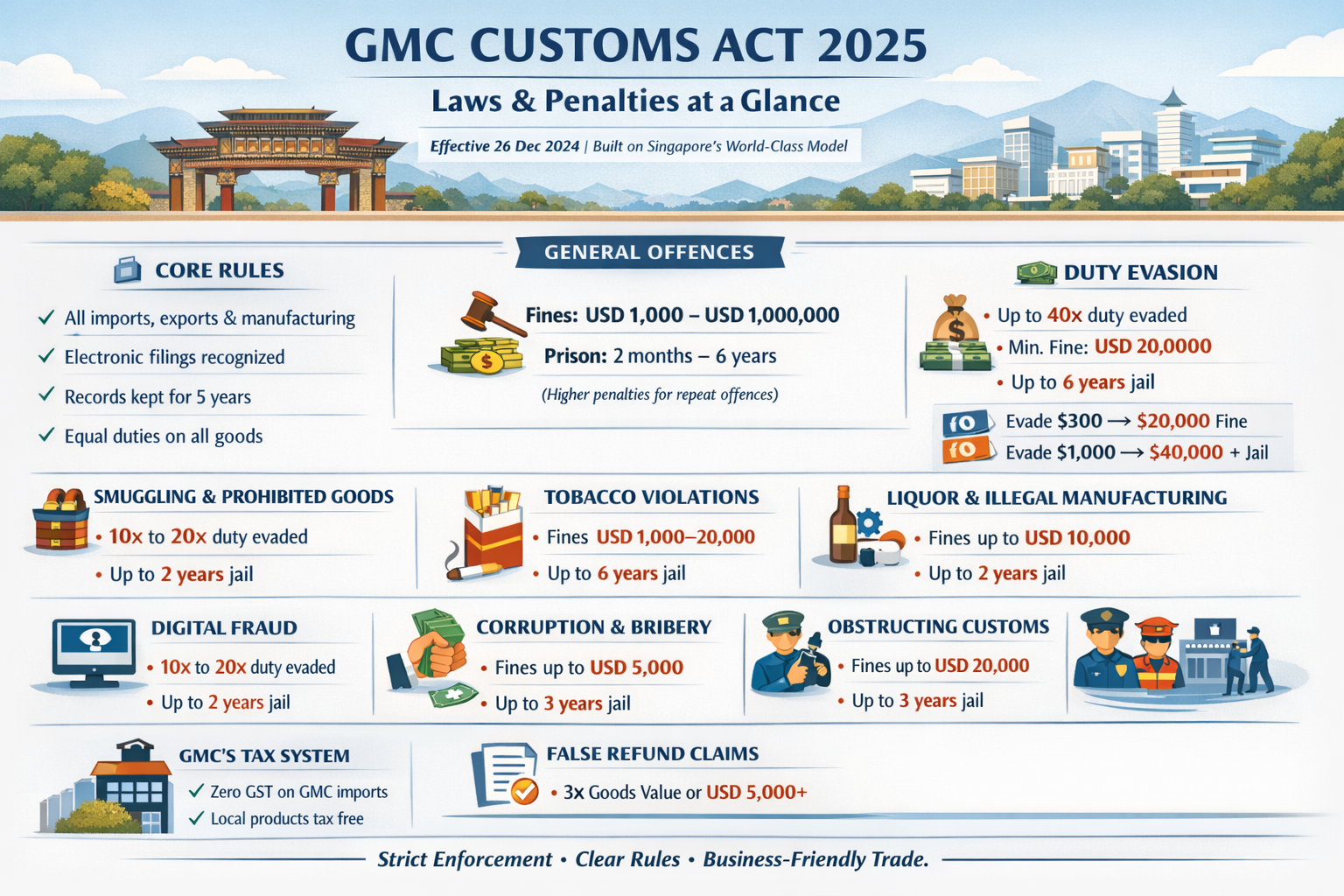
Penalties for customs violations range from USD 1,000 to USD 1 million, with imprisonment terms spanning two months to six years depending on the severity and repetition of offences.
In cases of duty evasion, offenders may be fined up to 40 times the duty evaded, subject to a minimum fine of USD 20,000. For instance, evading USD 300 still triggers a USD 20,000 penalty, while evading USD 1,000 could result in a USD 40,000 fine and up to six years’ imprisonment.
Tough Measures Against Smuggling and Prohibited Goods
Serious offences such as smuggling and trading in prohibited goods carry fines of 10 to 20 times the evaded duty, along with prison terms of up to one year for first offences and up to two years for repeat violations.
The Act also treats possession of smuggled or duty-evaded goods as knowing involvement unless proven otherwise — closing loopholes often exploited in illicit trade.
Strict Controls on Tobacco and Intoxicating Liquor
Tobacco-related offences attract fines ranging from USD 1,000 to USD 20,000 and imprisonment of up to six years. Larger quantities exceeding two kilograms carry higher penalties, while repeat offenders face fines of up to 40 times the evaded duty or USD 20,000 and extended jail terms.
Adding harmful substances to intoxicating liquor — or storing and possessing such products — is punishable by fines of up to USD 10,000, imprisonment of up to two years, or both.
Unlicensed equipment or materials used for manufacturing dutiable goods or liquor can result in fines up to USD 5,000, imprisonment up to 18 months, or both.
Zero Tolerance for Digital Manipulation and Corruption
The Act explicitly targets digital fraud. Tampering with computer data to evade customs duties carries fines of 10 to 20 times the duty evaded or at least USD 5,000, with repeat offenders facing imprisonment of up to two years.
Customs officers who solicit or accept bribes, collude in illegal seizures, or abuse their authority can be fined up to USD 5,000, imprisoned for up to three years, barred from public service, or face a combination of these penalties. Those offering bribes are equally liable.
Firm Action Against Obstruction and Evasion
Assaulting or obstructing customs officers, rescuing seized goods, resisting arrest, or escaping custody carries fines up to USD 10,000 or imprisonment of up to 18 months for first offences. Repeat offences can result in fines of USD 20,000 or imprisonment up to three years, or both.
False or inflated claims for duty drawbacks are penalised by fines of three times the value of the goods or USD 5,000 — whichever is higher.
Corporate Accountability Built Into the Law
When offences are committed by companies, directors, managers, partners, and officers are automatically deemed responsible unless they can prove the offence occurred without their consent or knowledge.
Individuals are also legally accountable for actions carried out by their agents or employees in the course of business — reinforcing strong internal compliance systems.
Clear Trade Procedures for Efficiency and Transparency
Beyond enforcement, the Act introduces detailed operational frameworks to support smooth and legitimate commerce, including:
• Inspection and valuation procedures
• Licensing for manufacturing activities
• Warehousing and storage regulations
• Duty drawback mechanisms for exports
• Handling and disposal of seized goods
Electronic filings are fully recognised under the law, and businesses must retain trade records for a minimum of five years to ensure auditability and long-term transparency.
Fair and Non-Discriminatory Customs Duties
Customs duties apply equally to imported goods and those manufactured locally within GMC, ensuring a level playing field for all businesses.
All duties are paid into a dedicated GMC revenue account, strengthening fiscal governance within the SAR.
To avoid disrupting legitimate trade, goods may be released against sufficient security while disputes are resolved — a business-friendly provision that balances enforcement with operational continuity.
Independent Tax Regime to Prevent Double Taxation
In parallel with its modern customs framework, Gelephu Mindfulness City operates under a distinct tax system that remains separate from Bhutan’s nationwide Goods and Services Tax (GST) rollout.
As a Special Administrative Region, GMC has retained its existing sales tax structure, allowing businesses within the city to function independently from the national GST regime. Companies operating in GMC are not required to register for GST with the Royal Government of Bhutan and must instead register directly with GMC authorities to qualify for tax treatment under the SAR.
Goods and services imported by GMC-registered businesses are zero-rated for GST, a safeguard designed to prevent double taxation and preserve GMC’s competitiveness as a trade and investment hub. This zero-rating is accompanied by strict monitoring mechanisms to ensure the system is not misused.
To support this separation, GMC has established its own customs management systems at border check posts, where the movement of goods between GMC and the rest of Bhutan is treated as formal import-export activity. Compliance is closely tracked to maintain transparency and regulatory integrity.
Local agricultural products remain exempt from taxation, reinforcing support for domestic producers. However, wood-based products exported from GMC are subject to a 5% GST, while those imported into GMC from other parts of Bhutan attract a 20% sales tax — a calibrated structure aimed at balancing revenue collection with sectoral protection.
GMC Customs Act 2025 In A Nutshell
Positioning GMC as a Trusted Global Trade Gateway
With the GMC Customs Act 2025, Gelephu Mindfulness City is laying the legal and institutional foundations for a modern, transparent, and internationally credible trading environment.
By blending Singapore’s proven regulatory strength with Bhutan’s long-term economic vision, the framework sends a strong message to investors and businesses: GMC is open for trade — efficient, fair, and built to global standards.