
Project 108: Bhutan’s Ambitious Vision to Build a Line of Prayer Across the Land
Everything you need to know about the 108 Jangchub Chortens in Bhutan—an ambitious Project 108 initiative combining Buddhist symbolism, architecture, and a one-day construction effort on the 1st November 2026.
Mark your calendar. History is about to be made on the 1st November 2026.
Bhutan is preparing to undertake one of the most ambitious spiritual construction projects in its history—an initiative that blends engineering precision, cultural tradition, and collective purpose into a single act.
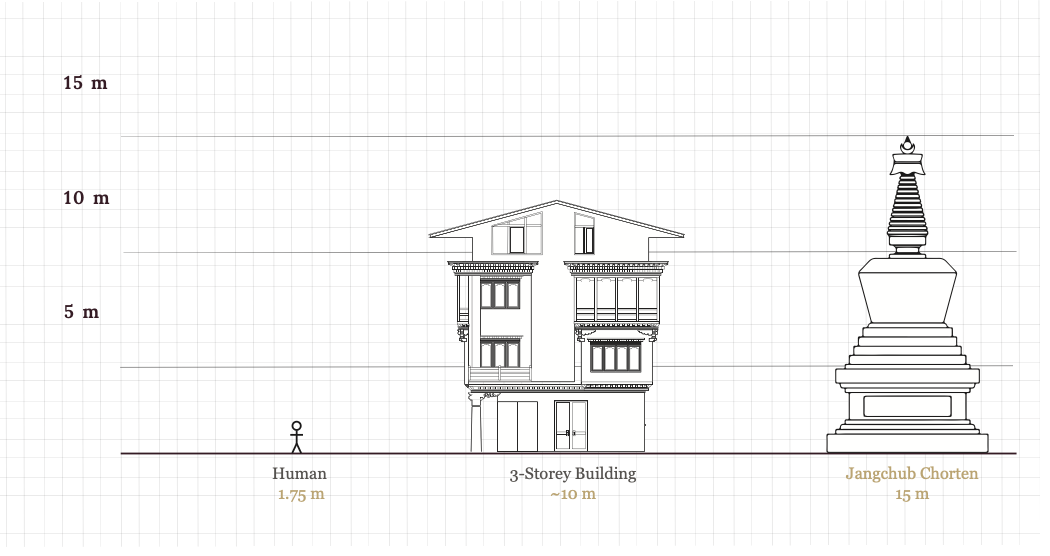
Known as Project 108, the Royal initiative will see the construction of 108 Jangchub Chortens (Stupas of Enlightenment), each 15 metres tall, completed together in a single coordinated day.
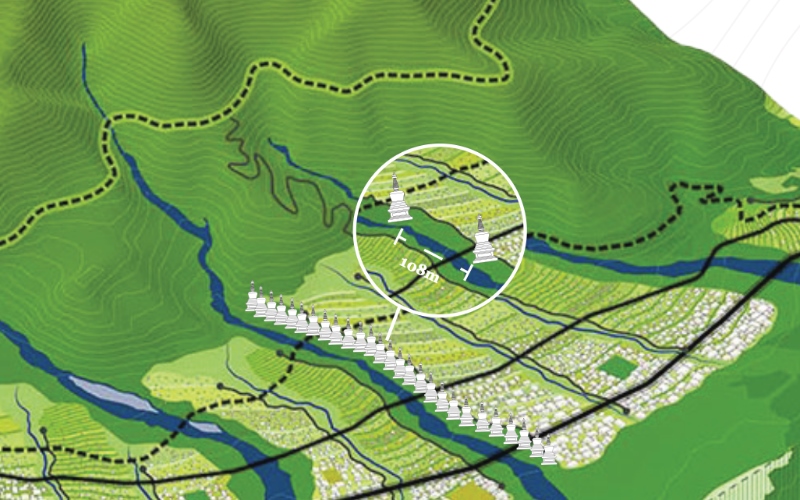
Planned along the Mao Chu river in Gelephu Mindfulness City (GMC), the project is not only architectural in scale—it is conceived as a symbolic offering of peace in a world facing growing uncertainty.
Origins of Project 108: A Royal Announcement
Project 108 was formally announced on 21 February 2026, coinciding with the birth anniversary of His Majesty King Jigme Khesar Namgyel Wangchuck.
The date carries national significance in Bhutan, often used for major Royal initiatives and policy directions. In his address, His Majesty King Jigme emphasised the deeper purpose behind the initiative, stating that such an effort reflects the collective strength of a people working together with shared intention.
Since the announcement, early groundwork has already begun along the Mao Chu, with volunteers mobilising to prepare sites—indicating that the project has moved quickly from concept to initial implementation.
A Line of Prayer Across the Landscape
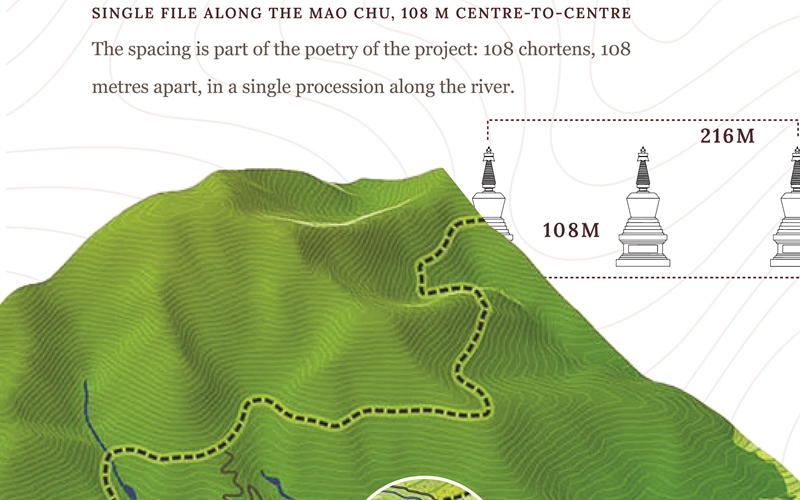
Unlike conventional monument clusters, the chortens will form a single-file procession stretching over 12 kilometres, each placed 108 metres apart.
This linear formation transforms the project into something more than infrastructure—it becomes a geometric expression of intention, described as “a line of prayer across the land.”
Each structure stands approximately 50% taller than a typical three-storey building and over eight times the hight of a person,rising prominently within the landscape.
If imagined vertically, the total combined height of all 108 chortens would reach 1.62 kilometres, nearly twice the height of the Burj Khalifa, the tallest building in the world.
These comparisons underscore the project’s scale—but its meaning lies elsewhere.
Understanding the Chorten: Architecture as Prayer
For international audiences unfamiliar with Himalayan Buddhism, a chorten (stupa) is not a building in the conventional sense. It is a sealed sacred structure, filled with prayers, relics, spiritual texts and ritual objects.
Chortens are understood as “a physical form of prayer, made permanent in stone and earth.”
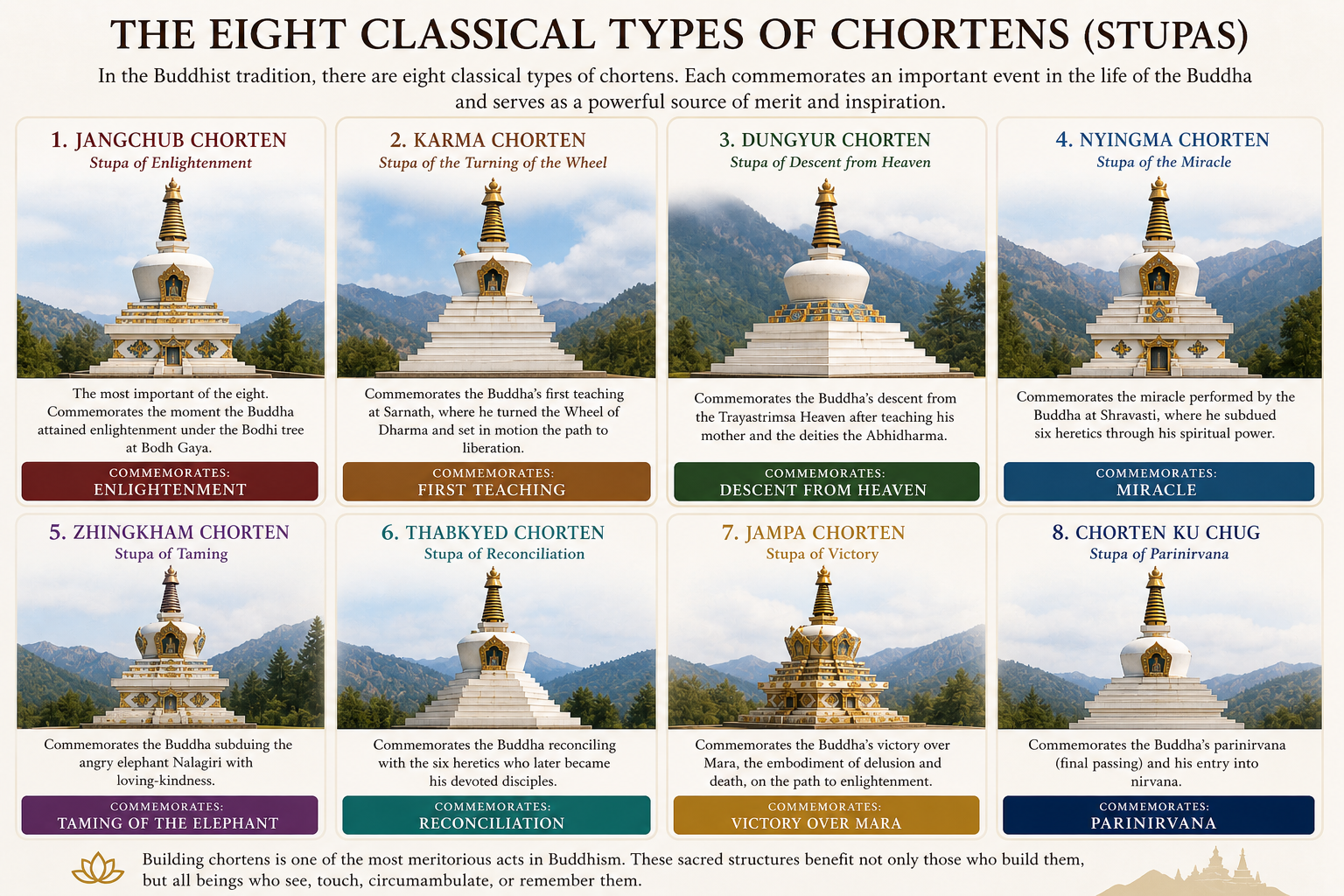
The design selected for Project 108 is the Jangchub Chorten, or Stupa of Enlightenment, the most significant of the eight classical types which commemorates the moment the Buddha attained enlightenment.
Anatomy of a Jangchub Chorten
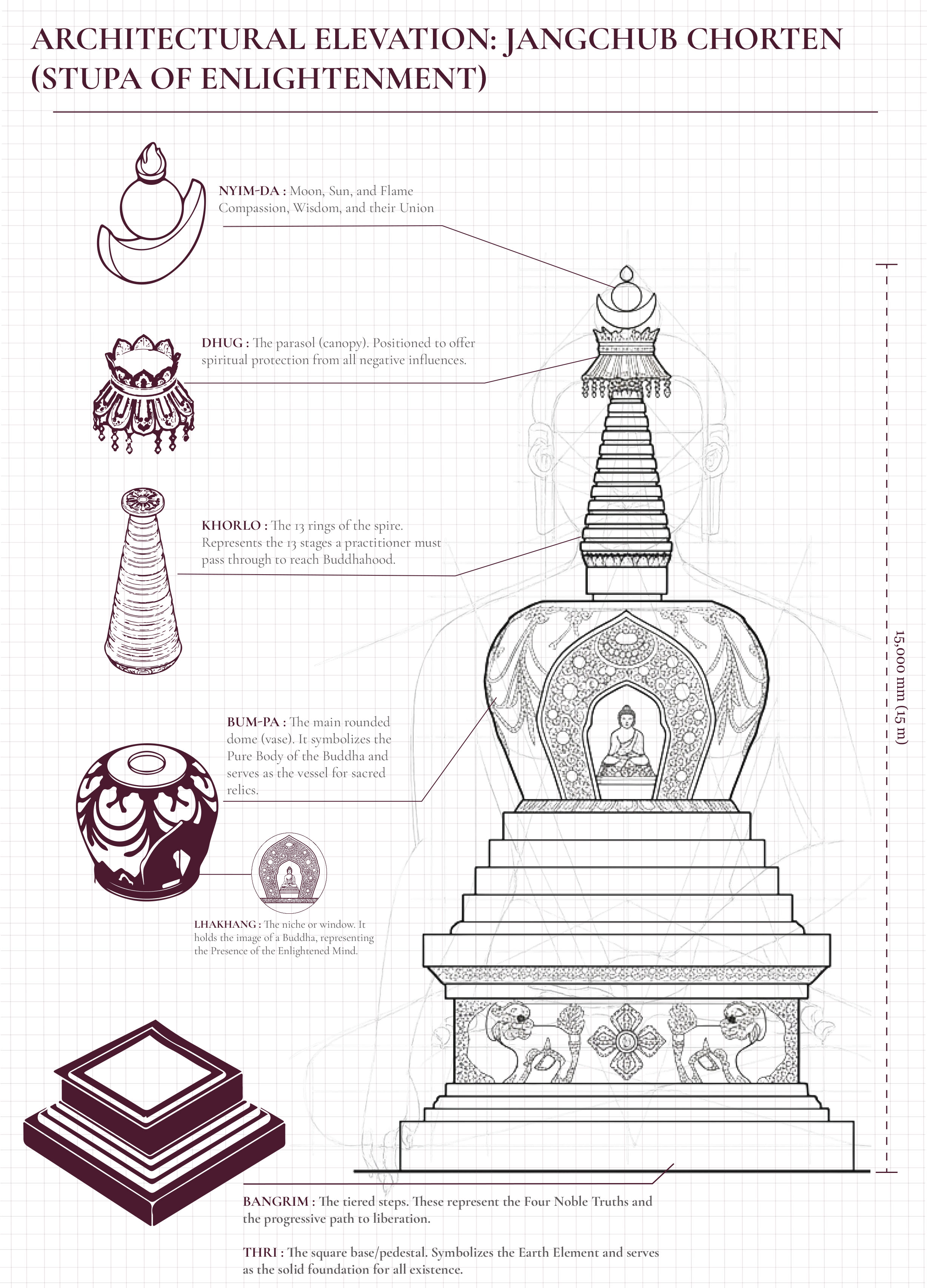
The Jangchub Chorten—also known as the Stupa of Enlightenment—is a structured expression of Buddhist philosophy. Every architectural element carries symbolic meaning, forming a three-dimensional representation of the path to awakening.
At its base lies the thri, a square pedestal representing the earth element and the foundation of all existence. Above it rise the bangrim, a series of tiered steps that symbolise the Four Noble Truths and the progressive path toward liberation.
The central dome, known as the bum-pa, is the defining feature of the chorten. Rounded and expansive, it represents the body of the Buddha and serves as a sacred vessel, traditionally filled with relics, prayers, and ritual objects.
Embedded within the structure is the lhakhang, a small niche or window that holds an image of the Buddha—signifying the presence of the enlightened mind within the form.
Above the dome rises the khorlo, the spire composed of 13 rings. These represent the 13 stages a practitioner must pass through on the journey toward Buddhahood, marking a gradual ascent from ignorance to enlightenment.
Crowning the structure is the dhug, or parasol, symbolising spiritual protection from negative forces. At the very top sits the nyim-da—the union of sun, moon, and flame—representing compassion, wisdom, and their inseparable unity.
Together, these elements transform the chorten into a complete spiritual diagram—one that communicates, through form rather than words, the principles at the heart of Buddhist practice.
Why 108? A Number Across Cultures
The number 108 is central to the project’s concept and scale.
108 is significant across spiritual traditions and even astronomy:
- In Buddhism, prayer malas contain 108 beads, and rituals often repeat actions 108 times. Temple bells in some traditions are rung 108 times to mark purification
- Hindu traditions recognise 108 sacred texts (Upanishads)
- Astronomically, the distance between Earth and the Sun—and Earth and the Moon—is approximately 108 times their respective diameters
- Mathematically, 108 is sometimes noted for its elegant structure as 1¹ × 2² × 3³, a pattern that has drawn interest for its symmetry
In Project 108, the number is not symbolic decoration—it is structural logic:
108 chortens, spaced 108 metres apart, forming a complete and unified whole.
One Day, 40,000 Volunteers
Perhaps the most striking aspect of Project 108 is its timeline.
The external structures of all 108 chortens are planned to be completed on a single day: 1 November 2026, following extensive preparation.
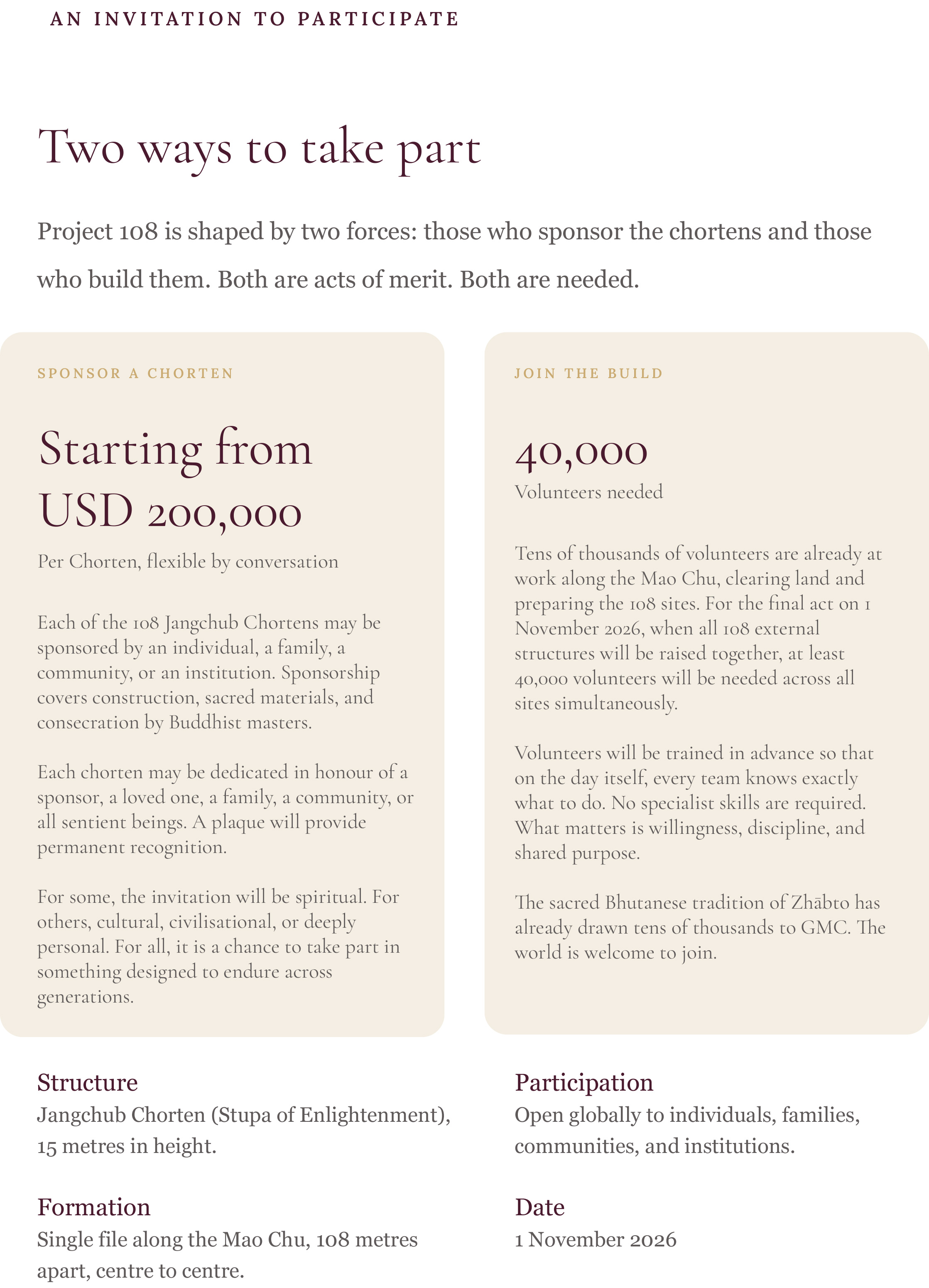
This effort will require at least 40,000 volunteers, working simultaneously across all sites.
The concept draws from the Bhutanese tradition of zhabto—voluntary communal labour performed as a form of spiritual practice.
The document describes how participation has already begun:
- Volunteers from across Bhutan are clearing land and preparing sites
- Participants include monks, students, professionals, farmers, and members of the diaspora
- International interest is emerging, with global participants expected to join
Unlike historical mega-projects driven by state power or labour systems, Project 108 emphasises voluntary participation and shared intention.
A Workforce to Rival History
To contextualise its scale, the following comparisons illustrate the labour behind some of history’s most iconic constructions:
- Great Pyramid of Giza: 20,000–30,000 workers over ~20 years
- Taj Mahal: ~20,000 artisans over ~22 years
- Great Wall of China: built over centuries
By contrast, Project 108 aims to mobilise 40,000 people in a single day—a feat that is less about duration and more about coordination and collective will.
Rooted in Tradition, Built for Today
The initiative also draws inspiration from Himalayan history.
According to tradition, the 7th-century Tibetan king Songtsen Gampo established a network of 108 temples across the Himalayas, including sites in Bhutan such as Kyichu Lhakhang and Jambay Lhakhang.
Project 108 echoes this legacy—but reinterprets it for a modern context, combining:
- Urban planning within Gelephu Mindfulness City
- Contemporary engineering and logistics
- Global participation and outreach
Progress and Readiness
The project is already underway in multiple areas:
- The site has been confirmed, stretching over 12 km
- The Jangchub Chorten design is finalised
- Engineering planning and foundation work are in progress
- Materials sourcing and vendor discussions are ongoing
- Buddhist masters are actively guiding the project
This suggests the initiative is moving beyond concept into execution—though timelines and final delivery will depend on coordination at scale.
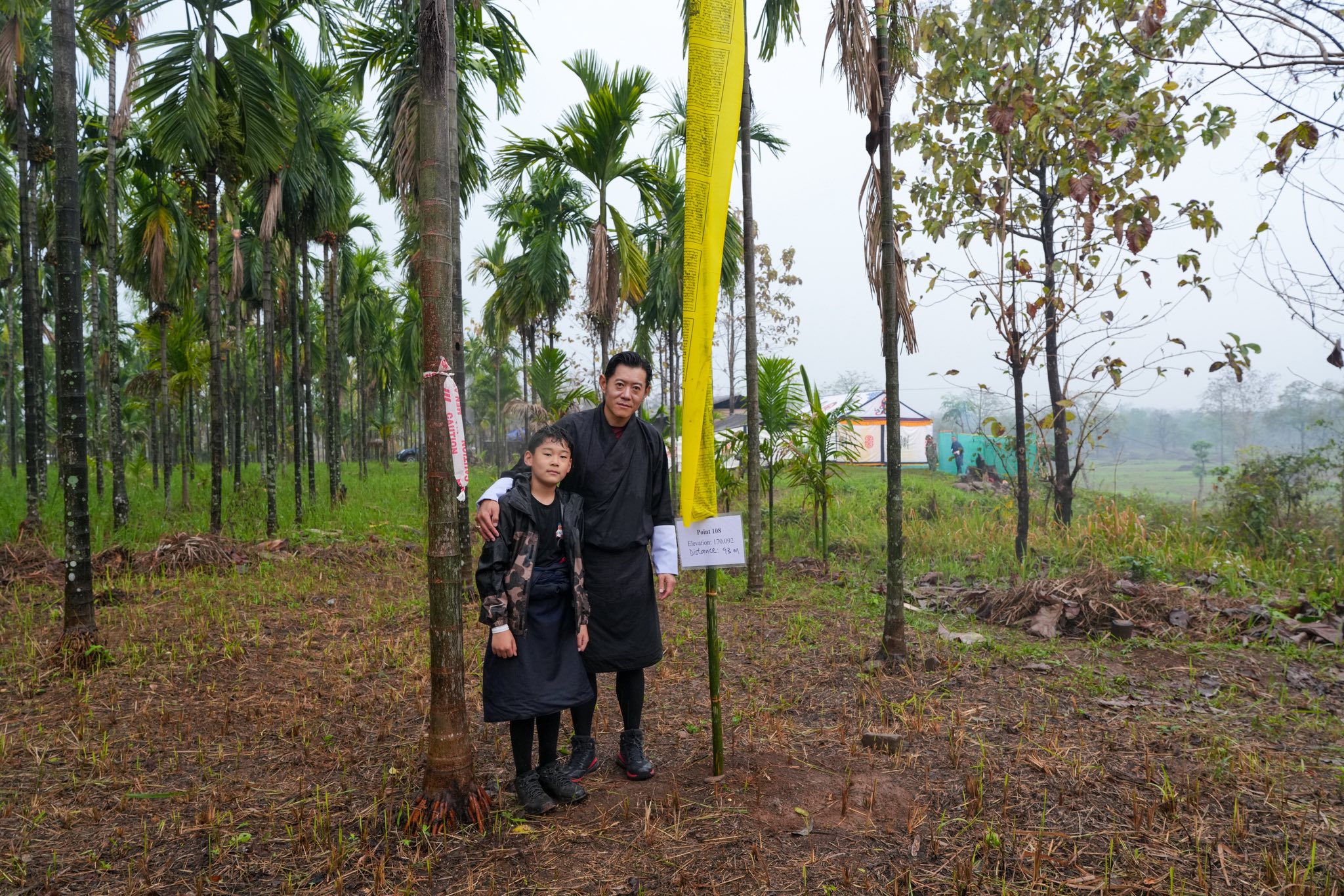 His Majesty King Jigme and His Royal Highness Prince Jigme at 108 Jangchub Chorten site
An Invitation to the World
Project 108 is not limited to Bhutanese participation.
The initiative invites global engagement in two main forms:
- Sponsorship of individual chortens (starting from USD 200,000)
- Volunteer participation in the construction effort
Each sponsored chorten may be dedicated to individuals, communities, or broader causes, with permanent recognition.
For more information, email 108@gmc.bt.
The Legacy of 108 Jangchub Chorten
At its core, Project 108 reflects a response to a world facing instability and fragmentation.
Described as “a collective act of prayer and spiritual practice, a reminder of the need for peace and spiritual protection,” the initiative also reveals something closer to home: the capacity of a nation to mobilise around shared purpose.
In bringing together tens of thousands in a single coordinated act, Bhutan is not only building chortens—it is demonstrating a model of collective effort rooted in culture, discipline, and unity. To demonstrate the ability to build something sacred, together, as an offering of peace to a world that needs it.