

Why Bhutan is More Relevant Than Ever Today
Forty years of Bhutan-Germany relations reveal why Bhutan’s approach to happiness, sustainability, culture, and long-term development continues to inspire global conversations today.
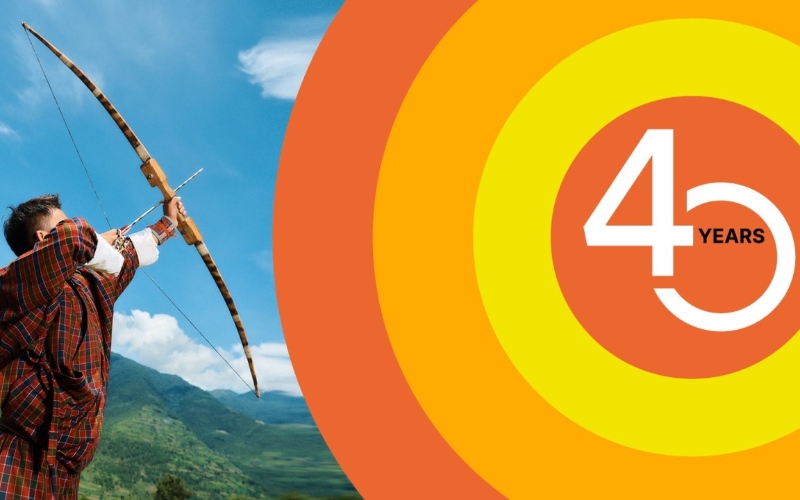
In the mid-1980s, 40 years ago, something unusual happened: A group of people in Germany founded a society dedicated to a small Himalayan kingdom. Not for economic reasons. Rather, it was born out of genuine curiosity about a culture with a different approach to development.
At that time, Bhutan had just begun to cautiously open up to the world. It was precisely at this moment that the German Bhutan Himalaya Society was founded, acting as a bridge between two worlds that could hardly be more different.
On 30 May 2026, we celebrated the 40th anniversary of this special connection alongside the Ambassador of Bhutan, Tshoki Choden, and the Minister of Foreign Affairs, Lyonpo D. N. Dhungyel. Four decades of cultural exchange, sustainable development projects and mutual learning lie behind us.
However, this article is not an anniversary speech. Instead, it is an attempt to understand why Bhutan is currently asking questions that extend far beyond its own borders, particularly with regard to businesses and societies under constant pressure to change and succeed.
When I Met the King: An Encounter That Stayed With Me

Some time ago, I had the opportunity to meet King Jigme Khesar Namgyel Wangchuck in person. It was not so much the monarch’s formal role that impressed me, but the attitude behind it: a sense of calmness and attentiveness, coupled with a remarkable interest in the long-term issues facing his country.
Our conversation centred on young people, economic prospects, social change and how Bhutan can continue to develop without losing its cultural identity.
What has stayed with me most is not a specific statement, but the way he listened. Not that polite kind of listening where the next reply is already being prepared in one’s mind. Rather, it was a genuine presence. It was at that very moment that I realised that Bhutan is far more than just a fascinating travel destination. It also reflects the issues that preoccupy many societies today.
1986 Marked the Beginning of a Different Conversation About Development

The mid-1980s were a time of rapid change. Germany was experiencing an economic boom, technological progress and growing prosperity. At the same time, Bhutan was cautiously emerging from centuries of isolation — not through radical modernisation, but through a considered approach to development. It was precisely within this context of tension that the German Bhutan Himalaya Society was founded.
People recognised that Bhutan was daring to do something that had become rare in many Western societies: asking what kind of society one actually wants. The Fourth King of Bhutan encapsulated this idea in a phrase that still resonates today:
'Gross National Happiness is more important than Gross Domestic Product.'
This statement was never intended as a rejection of economic development. Instead, it prompted an attempt to define progress more comprehensively by taking into account not only growth, but also social well-being, cultural identity and ecological responsibility.
Thus, Gross National Happiness evolved into a concrete development model comprising nine domains and numerous indicators, ranging from mental well-being and cultural diversity to the environment and community.
This is precisely what makes Bhutan particularly relevant to this day.
Measuring Development Differently Changes What Societies Value
Gross National Happiness is neither romantic nor naive. It is an attempt to view development as more than just an economic issue.
The 2022 Gross National Happiness survey found that 48.1 per cent of Bhutan's population described themselves as deeply or moderately happy. Meanwhile, countries such as Iceland, New Zealand, Scotland and Wales have increasingly integrated wellbeing-oriented frameworks into political decision-making. As early as 2011, the United Nations adopted a resolution encouraging member states to incorporate well-being more fully into political decision-making processes.
What began as an idea from a small Himalayan kingdom has evolved into an increasingly global discussion: how do we measure progress? This raises an uncomfortable question for businesses: we measure turnover, efficiency and productivity very precisely. But how often do we measure trust, a sense of belonging, identification or cultural stability?
This important insight comes from 40 years of relations with Bhutan. What we measure influences what we value.
Clean Water, Education and Community Show How Long-Term Leadership Works

The German Bhutan Himalaya Society is involved in a project that was initiated by the Rotary Club of Thimphu, the capital city of Bhutan: the drinking water project for schools. To date, over 130 schools have been supplied with clean drinking water in collaboration with many international partners. Thousands of children now benefit directly from this. The long-term aim is to provide all schools in the country with access to safe water filtration systems.
At first glance, this looks like classic development cooperation. However, the project actually demonstrates something more fundamental: long-term impact is achieved by considering infrastructure, education, health, and community development together. When children have to spend several hours a day fetching water or frequently fall ill due to contaminated surface water, their educational opportunities, social stability and long-term development are all affected.
A parallel can be drawn here with the corporate world: investments in quality of life have long-term economic benefits. Where people feel connected, culture thrives and community is fostered, more resilient organisations often emerge.
Many companies today are finding that short-term optimisation can generate long-term costs, such as higher staff turnover, reduced company loyalty, mental exhaustion and declining innovation. One of the key insights is that sustainable performance never arises in isolation. It always emerges from a larger overall system.
Bhutan’s Challenges Reveal the Complexity of Sustainable Development

This is precisely why Bhutan is an interesting case: it is not a perfect counter-model to the Western world. Bhutan faces enormous challenges, too. Youth unemployment is high. Many young Bhutanese people are leaving the country to seek opportunities abroad. For a small country of fewer than a million inhabitants, this represents profound social change.
Bhutan has preserved its cultural identity, environmental awareness and social stability for an exceptionally long time. However, insufficient economic prospects have been created for the next generation. This is precisely why Bhutan is currently undergoing a remarkable process of transformation.
In the south of the country, the Gelephu Mindfulness City development project is taking shape. The project aims to combine international investment, sustainable technologies, education, and new economic opportunities with Bhutanese values. Ultimately, this boils down to one central question: how can economic openness be achieved without losing cultural identity?
Rather than providing perfect answers, Bhutan's true strength lies in demonstrating just how complex development actually is. Long-term thinking does not mean clinging rigidly to a single model. Rather, it means recognising in good time when conditions are changing and adaptation becomes necessary.
Spaces Shape Behaviour More Than We Often Realize

One of the most surprising insights from Bhutan concerns spaces. In Bhutan, spaces are not just understood in functional terms, but as part of an attitude. Monasteries, courtyards and communal spaces often possess a unique quality that fosters tranquillity, mindfulness and connection. Not through luxury. Rather, this is achieved through proportion, materiality, light and deliberate transitions.
I asked myself: why do many modern working environments, despite having perfect facilities, often have the opposite effect? Why do some offices feel noisy, anonymous or constantly stimulating? For many years, work environments were primarily optimised for efficiency rather than for human energy, concentration or community.
At feco, we have noticed that companies are no longer just looking for functional workspaces. They want spaces that foster a sense of belonging, identification and creative energy.
That is why we now talk much more about different atmospheres: Spaces for focus. Spaces for community. Spaces for retreat. Spaces for inspiration. This is because spaces influence our behaviour far more than we often realise. They shape how we communicate, listen, think and collaborate.
People do not need constant stimulation. Above all, they need balance.
Genuine Listening Changes the Quality of Leadership
Another experience from Bhutan has changed my view of leadership: the importance of paying attention. Conversations there often feel less transactional. More time is given to listening. Not every question requires an immediate response. Not every uncertainty needs to be resolved instantly. This may sound simple at first. In practice, however, it changes the way decisions are made.
Good leadership does not always mean providing quick guidance. Sometimes it also means tolerating complexity, listening, and deliberately leaving questions unanswered.
Many problems in companies do not primarily arise from a lack of strategy, but from people not feeling truly heard. The future lies in the quality of our attention.
Long-Term Relevance Requires Continuous Reinvention

The greatest danger for long-standing institutions is not change itself. It is the loss of relevance through repetition. This is why the German Bhutan Himalaya Society (Deutsche Bhutan Himalaya Gesellschaft e. V.) aims to play a vital role in showcasing Bhutan as a cultural heritage site and a valuable partner in discussions about the issues of the future.
This is precisely where Bhutan’s true strength lies today. Not in romanticised notions of a Himalayan kingdom. But in questions such as:
- How can we shape sustainable development?
- How can we combine economic progress with cultural identity?
- How can societies maintain their integrity in times of global acceleration?
- And how does community emerge in an increasingly digital world?
These questions have long since ceased to concern Bhutan alone. They also concern companies, organisations and societies in Europe. The significance of this 40-year relationship lies precisely in this: not in exchanging ready-made answers, but in reflecting together on the future.
Growth Alone Does Not Answer the Question of a Good Life
What is the point of all this growth if it leaves people feeling emotionally drained? Many young people today feel keenly that material progress does not automatically create meaning, a sense of belonging or a good quality of life.
Bhutan reminds us that development is not the only option. It is possible to think economically while also talking about community. It is possible to modernise while preserving one’s cultural identity. We can strive for progress while asking what people really need for a good life.
Therefore, Bhutan is more relevant today than ever before, not as a distant kingdom in the Himalayas, but as a mirror reflecting questions that concern us all.
Small Changes in Attention Can Change Entire Cultures

Change often begins more quietly than we realise.
- Tomorrow, take five extra minutes in a conversation to truly listen.
- Without replying immediately.
- Without checking your phone.
- Without preparing your next response in your head.
It sounds simple. Yet this is often where real transformation begins. The future is not shaped by grand strategies alone. It is also shaped by the quality of our attention towards one another.
That may be the most important insight from 40 years of relations between Germany and Bhutan: We can become more technologically advanced — as long as we do not become poorer in human terms along the way.